

Secondary Heating Systems: Planning for Boiler Redundancy
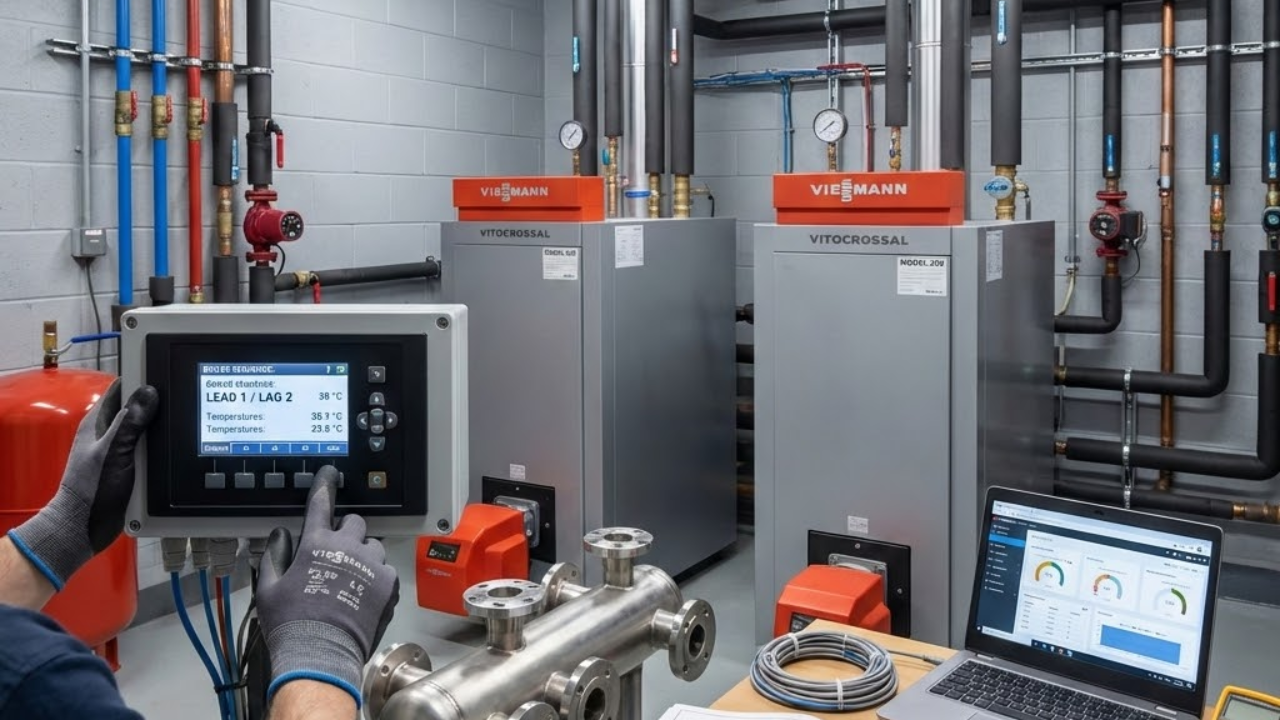
A single boiler powering an entire commercial building is a single point of failure. When that boiler breaks down (not if, but when) your building goes cold. In a hotel, that means cancelled bookings and refund demands. In a care home, it means vulnerable residents at risk and potential regulatory action. In a manufacturing facility, it means production lines stopped and tens of thousands of pounds lost per day.
Yet we still see commercial buildings designed with one oversized boiler handling 100% of the heating load, with nothing backing it up. This isn't bold engineering or cost optimisation. It's risk mismanagement, pure and simple. The question isn't whether you can afford redundancy in your heating system. It's whether you can afford not to have it.
Secondary heating systems (backup capacity built into your primary heating design) aren't just for mission-critical facilities. They make financial sense for any commercial building where heating failure creates significant operational, financial, or reputational damage. This guide explains how to design heating redundancy properly, what it costs, and why the investment pays for itself the first time your primary boiler needs emergency service. Heating and Plumbing World supplies comprehensive multi-boiler installation components and control systems for commercial applications.
Why Commercial Buildings Need Heating Redundancy
Start by quantifying what heating failure actually costs your operation. For a hospital or care home, the consequences extend beyond money. Patient and resident safety depends on maintaining adequate heating. Healthcare Technical Memorandum HTM 04-01 explicitly requires backup heating capacity for healthcare facilities, recognising that loss of heating constitutes a genuine safety risk for vulnerable people.
The same principle applies to care homes, nursing facilities, and specialist housing for elderly or disabled residents. You have a legal duty of care to maintain safe environmental conditions. "The boiler's broken, we're waiting for an engineer" doesn't absolve you of that responsibility. Local authorities and regulators expect redundant capacity for buildings housing vulnerable occupants.
Think of heating redundancy like having two engines on a passenger aircraft. Either engine can keep the plane flying safely, but you'd never design a commercial aircraft with just one. The consequences of failure are too severe, and the cost of redundancy is trivial compared to the value of what you're protecting.
Manufacturing and industrial facilities face different but equally serious consequences. When production lines stop due to heating failure, you're not just losing today's output. You're missing delivery deadlines, disappointing customers, and potentially triggering penalty clauses in supply contracts. A pharmaceutical manufacturer we worked with calculated that heating system downtime costs £15,000 per day in lost production, plus an additional £8,000 daily in staff costs for workers who can't work but must be paid. A two-day emergency boiler repair? That's £46,000 lost revenue.
Hotels, apart from the obvious guest comfort issue, face booking cancellations and review site damage that persists long after the heating is fixed. TripAdvisor doesn't distinguish between "heating failed due to unforeseeable fault" and "hotel doesn't maintain equipment properly." Both read as "stayed here in January, froze all night, would not recommend." That reputational damage takes months to recover from.
Even standard office buildings suffer meaningful financial impact from heating failure. Most commercial leases include heating as an essential service. If you can't provide it, tenants may have grounds to withhold rent or terminate leases. Plus, sending staff home because the building's too cold to work means paying salaries for zero productivity.
Understanding N+1 Redundancy Principles
The engineering term for backup capacity is "N+1 redundancy." N represents the number of units needed to handle the full load. The +1 represents one additional unit providing backup. For commercial heating, this typically means designing a multi-boiler system where the loss of any single boiler doesn't eliminate your heating capacity.
A simple example: a building requiring 600kW of heating capacity might use a 2+1 configuration. Two boilers each rated at 300kW handle normal operation, with a third 300kW boiler on standby. If any boiler fails, the remaining two still provide the full 600kW needed. This is true N+1 redundancy. Full capacity even with a single component failure.
Capacity sizing in N+1 systems requires careful thought. You have two main approaches. First, each boiler can be sized to handle the full load independently. A building needing 400kW could have two 400kW boilers from Andrews heating systems. One runs normally, the other sits as backup. If the primary fails, the backup takes over completely. This provides perfect redundancy but means you've installed 800kW of plant to serve a 400kW load. Expensive in capital terms.
The second approach uses proportional sizing through dual-boiler configurations. Three boilers each rated at 250kW give you 750kW total capacity to serve a 500kW load. Under normal operation, two boilers run whilst one remains on standby. If one fails, the remaining two still provide 500kW. This delivers redundancy at lower capital cost because you're not doubling your entire plant capacity.
Design day coverage becomes critical in proportional systems. Your boiler sizing must account for the coldest weather conditions your building will experience. If you size boilers based on average winter conditions, you'll have adequate redundancy most of the time but potentially insufficient capacity during cold snaps. CIBSE weather data provides design temperatures for different UK regions. Use these figures, not optimistic assumptions.
Lead-lag rotation prevents one boiler from sitting idle for months whilst another runs continuously. Modern controls rotate which boiler acts as lead, ensuring even wear across all units. A three-boiler system might rotate weekly: Boiler 1 leads week one, Boiler 2 leads week two, Boiler 3 leads week three, then back to Boiler 1. This extends equipment life and ensures standby boilers remain operational when needed.
Dual-Boiler Systems: The Baseline Approach
For many commercial buildings, a dual-boiler configuration hits the sweet spot between cost and reliability. Two equally-sized boilers, each handling roughly 60% of the total design heating load, provide meaningful redundancy without the capital expense of full N+1 systems.
Normal operation has both boilers running at moderate firing rates, sharing the load. This is actually more efficient than a single large boiler cycling on and off. Modulating boilers achieve best efficiency at mid-range firing rates, not at maximum output or during frequent cycling. Two boilers running at 40-60% load typically deliver better overall efficiency than one boiler running at 80% load.
When a single boiler fails, the remaining unit covers approximately 60% of the heating requirement. You won't maintain full comfort in all spaces, but you keep critical areas warm whilst emergency repairs proceed. This is where control integration matters. Zone valves like Danfoss thermostatic valves should be configured to prioritise essential spaces (occupied areas, temperature-sensitive equipment, frost protection) over non-essential zones (corridors, storage, rarely-used spaces) when operating on reduced capacity.
The cost balance favours dual-boiler systems for most standard commercial applications. Installing two 300kW boilers instead of one 500kW unit might add £15,000-£20,000 to the initial capital cost. But you gain operational flexibility, better efficiency at partial loads, and the ability to service one boiler without losing all heating. That £20,000 premium pays for itself the first time you avoid a full system shutdown.
Cascade Control and Automatic Switchover
Redundant boilers are useless if switching between them requires manual intervention. A boiler failure at 3am on a Sunday morning should trigger automatic switchover to backup capacity, not wait for someone to arrive on-site and press buttons. That's where cascade control systems earn their value.
Modern boiler controllers communicate via BUS systems, allowing a master controller to sequence multiple boilers based on heating demand. The lead boiler fires first, modulating from minimum to maximum output. If demand exceeds what the lead boiler can provide, the lag boiler fires. If demand drops, boilers shut down in reverse order. This happens automatically, hundreds of times per heating season, optimising efficiency and runtime distribution.
Outside temperature compensation improves cascade sequencing. Rather than reacting purely to flow temperature or thermostat calls, the system anticipates heating demand based on outdoor temperature. On mild days, one boiler at low fire might suffice. During cold snaps, both boilers fire aggressively. This anticipatory control delivers better comfort whilst reducing cycling.
Automatic failover requires sensors that detect when a boiler has genuinely failed versus temporarily satisfied demand and shut down normally. Flow temperature sensors confirm the boiler is producing heat when it should be. Pressure differential switches verify that the circulator is running and water is flowing. Flame failure signals from the burner controller indicate problems with ignition or fuel supply. The cascade controller processes these inputs and switches to the standby boiler when primary boiler faults are detected.
Response times for automatic switchover typically range from 30-60 seconds. The system detects a fault, attempts a restart (most faults are temporary and clear on reset), and if restart fails, activates the standby boiler. For most buildings, a 60-second interruption in heating is imperceptible. The building thermal mass maintains temperature whilst switchover completes.
Low-Loss Headers vs Direct Piping
Multi-boiler systems require proper hydraulic design to ensure each boiler sees appropriate flow rates and return temperatures. You have two main approaches: low-loss headers or direct piping with pressure-independent controls.
Low-loss headers create a vertical section of large-diameter pipe that hydraulically decouples the boiler primary circuit from the building secondary circuits. Each boiler pumps into the header at its design flow rate, and each building circuit draws from the header at whatever flow rate it needs. The header acts as a buffer, allowing flow rates to vary independently between primary and secondary circuits.
This matters because boilers need minimum flow rates to prevent short cycling and ensure even heat distribution across heat exchanger surfaces. Building circuits, particularly those with thermostatic radiator valves or zone controls, have highly variable flow requirements. Without hydraulic separation, closing zone valves can drop boiler flow below acceptable minimums, causing cycling and efficiency losses.
Thermal stratification in a properly designed low-loss header keeps the coldest return water at the bottom, ensuring boilers always see return temperatures that maximise condensing efficiency. Hot flow water rises to the top, feeding the building circuits. This natural stratification optimises system performance without complex controls.
Low-loss headers also simplify multiple boiler connection. Each boiler connects to the header independently with its own pump and controls. Adding or removing boilers requires minimal pipework changes. For systems with three or more boilers, headers become almost essential for clean hydraulic design.
The alternative is direct piping with carefully designed primary circuits and pressure-independent zone controls. Modern variable-speed pumps from Grundfos circulation pumps can maintain stable differential pressure regardless of flow rate, effectively creating hydraulic separation without a physical header. This works well for dual-boiler systems where space is limited and control sophistication is high.
Cost factors into the decision. A commercial-grade low-loss header with all connections, insulation, and installation typically costs £2,000-£5,000 depending on size. For a three-boiler system, that's a modest addition to overall plant cost and provides operational flexibility that's difficult to achieve otherwise.
Capacity Planning: Full vs Proportional Redundancy
How much redundancy is enough? The answer depends on your risk tolerance and budget constraints. Full redundancy means installing double the required capacity, ensuring no loss of heating even with major failures. Proportional redundancy accepts some capacity reduction during single failures but maintains enough heating to keep operations running.
Full redundancy makes sense for critical facilities where any capacity loss is unacceptable. A hospital operating theatre suite, pharmaceutical manufacturing clean room, or data centre requiring precise temperature control can't tolerate even temporary heating shortfalls. These applications justify installing multiple boilers where N-1 units (any N-1 combination of boilers with one failed) still provide 100% of design capacity.
Example: A facility requiring 900kW might install three 450kW boilers. Normal operation uses two boilers (900kW available). If one fails, two remain operational (900kW still available). This costs significantly more in capital terms. You're installing 1,350kW of plant to serve a 900kW load. But you're buying absolute reliability.
Proportional redundancy suits most standard commercial buildings. A 600kW heating requirement might be served by three 200kW boilers. Normal operation runs two boilers (400kW), with one on standby. If a boiler fails, two remain operational providing 400kW, which is 67% of design capacity. During mild weather, that's plenty. During design day conditions (the coldest expected weather), you'll experience some temperature drop in non-critical areas but maintain acceptable conditions in priority zones.
The cost differential is substantial. Using our 600kW example, full redundancy (three 300kW boilers totalling 900kW capacity) might cost £65,000-£80,000 installed. Proportional redundancy (three 200kW boilers totalling 600kW capacity) might cost £50,000-£65,000. That £15,000-£20,000 saving often makes redundancy affordable for buildings that couldn't justify full doubling of capacity.
Integration with Modern BMS Controls
Secondary heating systems achieve their full potential when integrated with building management systems. Brands like Honeywell heating controls offer BMS platforms specifically designed for commercial heating applications, with sophisticated multi-boiler control capabilities.
Modern BMS systems monitor each boiler's status in real-time: firing rate, flow and return temperatures, fault conditions, efficiency metrics, and runtime hours. This data feeds into automated control algorithms that optimise system operation. The BMS selects which boilers to run based on current demand, outdoor temperature, and equipment condition. It rotates lead boilers to distribute wear evenly. It stages boilers on and off smoothly to minimise cycling.
Predictive maintenance becomes practical with proper monitoring. When a boiler accumulates specified runtime hours, the BMS flags it for service. When efficiency starts dropping (evidenced by lower output temperatures at equivalent firing rates), the system alerts maintenance staff before problems become serious. This shifts maintenance from reactive (fixing breakdowns) to proactive (preventing failures).
Energy optimisation algorithms get more sophisticated as more boilers are available. A three-boiler system might determine that running one boiler at 80% is more efficient than running two at 40% during low-demand periods. Or it might prioritise the newest, most efficient boiler for lead operation whilst using older units only when necessary. These decisions happen automatically, optimising running costs without human intervention.
Remote monitoring lets facilities managers see system status from smartphones. A fault at midnight triggers an alert to the on-call engineer's phone, including diagnostic information that helps them decide whether immediate response is necessary or if it can wait until morning. For multi-site operations, central monitoring of all locations from a single dashboard becomes standard.
Maintenance Scheduling for Redundant Systems
Secondary heating systems need planned maintenance strategies that exploit redundancy to minimise disruption. The point of having backup boilers is using them during planned service windows, not just during emergencies.
Schedule annual boiler servicing during periods when reduced capacity is acceptable (spring and autumn shoulder seasons, or summer if you have hot water load only). With redundant boilers, you can service each unit individually whilst others maintain heating. A single-boiler building must either shut down completely for service or delay maintenance until summer. Neither option is ideal.
Annual rotation of lead-lag positions distributes runtime evenly across all boilers. If Boiler 1 acts as lead year-round, it accumulates triple the runtime of Boiler 2 and Boiler 3 on standby. After five years, Boiler 1 is worn out whilst the others are barely broken in. Rotating lead status ensures even component wear and synchronised end-of-life timing.
Six-monthly combustion analysis catches efficiency drift before it becomes costly. Burner air-to-fuel ratios drift over time. A boiler running at 85% efficiency rather than 92% wastes 8% of fuel consumed. On a 300kW boiler running 3,000 hours annually at £0.04/kWh for gas, that's over £2,800 wasted yearly. Combustion testing costs £200-£300. The payback is immediate.
Standby boilers need regular exercise even when not required for heating. Components seize, valves stick, and condensate traps dry out when boilers sit idle for months. Monthly firing cycles (running each boiler at operating temperature for 30-60 minutes) prevent these problems. Modern cascade controllers can automate this exercise cycling, ensuring standby boilers remain ready for immediate service.
Documentation tracking each boiler's individual history becomes increasingly valuable as systems age. Record service dates, parts replaced, combustion efficiency trends, and any operational issues. This data reveals patterns (Boiler 2 always needs heat exchanger cleaning more frequently) that inform future maintenance scheduling and help diagnose problems when they arise.
Legal and Regulatory Compliance
Certain building types face explicit legal requirements for heating redundancy. Healthcare facilities in England must comply with Health Technical Memorandum HTM 04-01, which mandates backup heating capacity. The guidance recognises that heating failure in hospitals poses direct risks to patient health and safety. Compliance isn't optional, it's a licensing requirement.
Care homes and residential facilities for vulnerable adults face similar obligations under Care Quality Commission regulations. Maintaining safe environmental temperatures counts as a fundamental care standard. Whilst CQC doesn't specify exact redundancy requirements, they expect providers to demonstrate reasonable precautions against foreseeable heating failures. A single boiler with no backup likely fails that test.
Commercial building insurance policies sometimes include specific clauses about heating system maintenance and redundancy. Check your policy. Some insurers require evidence of regular servicing, combustion testing, and (for buildings housing vulnerable occupants or critical operations) backup heating capacity. Operating without required backup could invalidate coverage in the event of heating-related claims.
Health and Safety Executive guidance on temperature in indoor workplaces establishes minimum standards (typically 16°C for office work, 13°C for physical labour). Employers have a duty of care to maintain these standards. If your single boiler fails and you can't provide adequate heating, you may be legally required to send staff home. For some operations, that constitutes a breach of your duty to provide safe working conditions.
Local authority licensing for houses in multiple occupation (HMOs) and similar residential buildings often includes heating adequacy assessments. Licensing officers increasingly expect redundancy or demonstrated backup arrangements (portable heaters, emergency repair contracts) for buildings housing multiple vulnerable tenants.
Cost Analysis: Single vs Redundant Systems
The capital cost premium for redundant heating is real but often smaller than facilities managers assume. A detailed comparison reveals that secondary systems often pay for themselves through operational savings and avoided downtime costs.
Single boiler system: £25,000-£35,000 installed for a 500kW condensing boiler with controls, flue, and commissioning. Low initial cost, straightforward installation, minimal plant room space required.
Dual-boiler system: £45,000-£60,000 installed for two 300kW condensing boilers with cascade controls, low-loss header, and commissioning. Higher capital cost, requires more plant room space, more complex installation.
The £20,000-£25,000 capital premium is the obvious difference. But now factor in operational costs. The dual-boiler system typically achieves 1-3% better overall efficiency due to better part-load performance and reduced cycling. On annual fuel costs of £30,000, that's £300-£900 yearly saving. Over a 15-year boiler lifespan, the efficiency gain alone recoups £4,500-£13,500 of the capital premium.
Add avoided downtime costs. A single boiler failure requiring 48 hours for emergency repair might cost a hotel £5,000 in cancelled bookings, a manufacturing facility £30,000 in lost production, or an office building £8,000 in staff sent home. The dual-boiler system avoids those costs by maintaining partial or full heating during repairs. A single avoided failure event often justifies the entire capital premium.
Maintenance scheduling flexibility adds further value. Being able to service boilers during normal operations rather than scheduling weekend or out-of-hours work reduces labour costs. Service engineers charge premium rates for emergency and after-hours calls. Planned maintenance during business hours costs 30-40% less.
Total cost of ownership over five years, accounting for capital, fuel, maintenance, and downtime risk, often favours redundant systems for all but the smallest commercial buildings. The break-even point typically falls around 200-300kW of heating capacity. Below that, single boiler economics win. Above that, redundancy starts making financial sense independent of operational criticality.
Future-Proofing Redundant Heating Installations
Secondary heating systems have one subtle advantage for long-term planning. They let you phase boiler replacements rather than facing simultaneous end-of-life on all equipment. A triple-boiler system installed in 2025 will likely need replacement starting around 2040. But you can replace one boiler at a time, spreading capital cost and maintaining continuous operation throughout the replacement programme.
Specify hydrogen-ready boilers if your installation timeline extends into the 2030s. The UK gas grid transition to hydrogen blends (and eventually potentially 100% hydrogen) means today's natural gas boilers may need adaptation or replacement. Hydrogen-ready appliances can be converted to burn hydrogen with relatively minor modifications. This protects your capital investment against fuel transition mandates.
Consider space provision for heat pump integration even if not installing pumps immediately. Hybrid systems combining heat pumps for base load with gas boilers for peak demand are increasingly common. If your plant room and electrical infrastructure can accommodate future heat pump addition, you've created an upgrade path that might be mandated by future regulations.
Control system architecture should assume future integration needs. Choose BMS platforms with open protocols (BACnet, Modbus) that can communicate with diverse equipment types. Avoid proprietary closed systems that lock you into single-vendor equipment choices for future expansions.
Plan for 15-year service life on commercial boilers as a reasonable baseline. Equipment might last longer with excellent maintenance, but financial planning should assume replacement around year 15. Stagger boiler ages in multi-boiler systems to avoid simultaneous end-of-life. If installing three boilers, consider specifying slightly different models or vintages to desynchronise their replacement timing.
Conclusion
Secondary heating systems aren't luxuries for paranoid facilities managers. They're sensible risk mitigation strategies that protect operations, satisfy regulatory requirements, and often deliver better overall efficiency than single-boiler installations. The upfront capital premium is real but modest, and the operational benefits (maintained heating during failures, service flexibility, and better part-load efficiency) usually justify the investment within 3-5 years.
The minimal viable redundancy for most commercial buildings is a dual-boiler configuration with automatic cascade control. Each boiler sized for 50-60% of design load provides meaningful backup capacity without the full capital doubling required for true N+1 systems. Critical facilities (healthcare, manufacturing, vulnerable housing) should consider full N+1 redundancy where any single failure leaves 100% capacity available.
Modern control systems make secondary systems nearly autonomous. Automatic lead-lag rotation, failover, and optimisation happen without operator intervention. Add BMS integration, and you gain remote monitoring, predictive maintenance alerts, and energy analytics that further justify the investment.
For comprehensive multi-boiler system components including low-loss headers, cascade controllers, and compatible boiler plant from professional heating components, our technical team provides support for commercial heating redundancy projects. To discuss secondary heating system design for your specific facility requirements, get expert advice on sizing, configuration, and control integration.