

Silicone Sealant for Bathrooms: Professional Application Guide
Moisture is the silent enemy of every bathroom and kitchen installation. A poorly sealed shower tray or a compromised joint around a sink can turn into a costly insurance claim within months. For heating and plumbing professionals, specifying the right silicone sealant for bathrooms isn't just about aesthetics. It's about preventing water ingress, mould growth, and structural damage that'll have you back on site long after the invoice is paid.
The right silicone sealant creates a flexible, watertight barrier that accommodates thermal expansion, substrate movement, and constant exposure to water and cleaning chemicals. Get it wrong, and you'll see black mould creeping through the seal within weeks, or worse, water tracking behind tiles and rotting out timber joists. This guide breaks down everything you need to know about selecting, applying, and maintaining silicone sealants in wet areas, from understanding the chemistry behind different formulations to avoiding the common installation mistakes that compromise even premium products. Heating and Plumbing World supplies professional-grade sealing materials for reliable wet area installations.
Understanding Silicone Sealant Chemistry
Not all silicones are created equal, and understanding the fundamental differences between formulations will save you from callbacks and failed installations.
Acetoxy-cure silicones are the traditional bathroom sealants you'll recognise by their vinegar smell during curing. They're affordable and create a strong initial bond, but they release acetic acid as they cure. This makes them incompatible with natural stone, cement-based materials, and metals like copper or brass. The acid will corrode or stain these surfaces. They're fine for ceramic tiles and acrylic baths, but that's where their application ends—these acetoxy-cure compatibility limitations restrict their use significantly.
Neutral-cure silicone formulations cost more but solve the compatibility problem. They release alcohol or oxime compounds during curing instead of acid, making them safe for virtually any substrate including marble, granite, concrete, and metal. For commercial bathrooms or high-end residential work, neutral-cure is the only sensible choice.
The antimicrobial fungicide additives built into bathroom-grade silicones separate them from general-purpose products. Bathroom sealants contain these additives that inhibit mould and mildew growth in permanently damp conditions. Standard silicones will turn black within months in a shower enclosure, whilst a properly formulated bathroom sealant should maintain its appearance for years.
Key Performance Characteristics
When you're comparing datasheets, focus on the specifications that actually matter in wet area applications.
Movement accommodation is critical. Quality bathroom silicones offer ±25% joint movement capability, meaning they can stretch and compress by a quarter of their original width without losing adhesion or tearing. This flexibility handles thermal cycling, substrate expansion, and building settlement. Cheap sealants with limited movement capability will crack and peel prematurely.
Adhesion strength determines whether the seal stays bonded when subjected to constant moisture and cleaning. Look for products that specify adhesion to wet surfaces. Some formulations will bond even to damp substrates, which is invaluable when you're working on occupied properties where you can't shut down a bathroom for 24 hours to dry out.
Shore A hardness specifications indicate the final flexibility of the cured sealant. Most bathroom silicones cure to between 15-25 Shore A. Soft enough to remain flexible but firm enough to maintain their shape and resist abrasion from cleaning. Anything significantly harder will be prone to cracking; anything softer may deform or tear.
Curing speed affects how quickly you can hand over the installation. Most silicones skin over in 10-15 minutes and cure at roughly 2-3mm per 24 hours from the exposed surface inward. A 10mm deep bead might take three days to fully cure in the centre, though it'll be serviceable much sooner. Temperature and humidity both accelerate curing. A warm, humid bathroom cures faster than a cold, dry one.
Bathroom-Specific Applications
Different areas of a bathroom present distinct challenges, and your sealant strategy should reflect that.
Shower trays and bath seals are the highest-risk areas. The joint between a tray or bath and the wall tiles experiences constant water exposure, thermal movement from hot water, and mechanical stress when someone steps in or out. This joint should always be sealed with a premium neutral-cure bathroom silicone with maximum movement capability. The old practice of using cement-based grout in these locations is asking for trouble. Grout is rigid and will crack, allowing water to penetrate behind the unit.
Here's the critical detail most installers miss: the joint should be sealed when the tray or bath is full of water. Fill it completely before applying the sealant. This loads the unit to its maximum deflection point, ensuring the seal is under compression when empty rather than tension when loaded. A seal applied to an empty bath will be stretched to its limit when someone fills it for the first time, and that's when failures occur.
Think of it like fitting a gasket on a flange connection. You'd never torque the bolts without the gasket compressed to its working position. Same principle applies here—load the bath first, then seal it at maximum deflection.
Tile joints and corners need careful consideration. Internal corners in shower enclosures should be sealed rather than grouted because the two walls move independently. A rigid grout line will crack; a flexible silicone joint will accommodate the movement. Use a neutral-cure product that matches or complements your grout colour. Danfoss valves are compatible with sealants for use with their hydronic heating systems that are often installed in luxury bathrooms.
Basin and sink perimeters are lower-risk but still require proper sealing. The joint between an undermount basin and a stone countertop should be sealed with clear neutral-cure silicone to prevent water tracking underneath and staining the substrate. Wall-hung basins need sealing where the pedestal or bracket meets the wall to prevent water running down behind the unit.
Kitchen Application Considerations
Kitchens present a different set of challenges. Less standing water than bathrooms, but more aggressive cleaning chemicals and higher mechanical stress.
Worktop joints around sinks and hobs are the primary sealing locations. The joint between a sink and a laminate or timber worktop is critical. Water penetration here will swell and destroy the substrate within weeks. Use a neutral-cure kitchen and bathroom sealant with excellent adhesion to both stainless steel and the worktop material. For natural stone worktops, neutral-cure is mandatory to avoid staining.
The technique matters here. Clean both surfaces thoroughly with isopropyl alcohol to remove any grease or residue that would compromise adhesion. Apply a continuous bead around the sink rim, press the sink into position, and immediately tool the excess sealant to create a neat fillet on both the top and underside of the joint. Don't wait until after the sink is secured. You need the excess sealant to squeeze out and form a complete seal.
Splashback joints where tiles meet worktops should be sealed rather than grouted for the same reason as bath seals. The worktop and wall move independently. A 5-6mm joint sealed with colour-matched silicone will accommodate movement and prevent water tracking behind the worktop. This is especially important around sinks where splashing is constant.
Appliance gaps around built-in ovens, dishwashers, and refrigerators may need sealing to prevent food debris and moisture accumulation. Use a neutral-cure sealant that can tolerate the higher temperatures around cooking appliances. Some installers use clear silicone for a less visible finish, though it will show dirt more readily than a colour-matched product.
Surface Preparation and Application Technique
Even the best sealant will fail if the application is rushed or the surfaces aren't properly prepared. This is where most installation problems originate.
Surface preparation is non-negotiable. Both surfaces must be clean, dry, and free from dust, grease, soap residue, and old sealant. Use a sharp blade to remove all traces of old sealant. Any residue left behind will prevent proper adhesion of the new material. Follow up with isopropyl alcohol or a dedicated silicone remover to eliminate any remaining contamination. For porous surfaces like natural stone, you might need to tape off the area to prevent the new sealant staining the surface.
Joint sizing directly affects performance. The ideal joint width is 6-10mm for most bathroom and kitchen applications. Narrower joints don't provide enough sealant mass to accommodate movement; wider joints may sag before they cure or take too long to cure through. The depth should be roughly half the width. A 10mm wide joint should be 5mm deep. Use backing rod or tape to control depth in deeper joints rather than filling them entirely with sealant.
Application method separates professional results from amateur work. Cut the nozzle at a 45-degree angle to the desired bead size. Move the gun smoothly along the joint at a consistent speed, maintaining steady pressure. The bead should be slightly proud of the joint. You'll tool it down in the next step. For internal corners, apply the sealant to both surfaces in one continuous movement if possible.
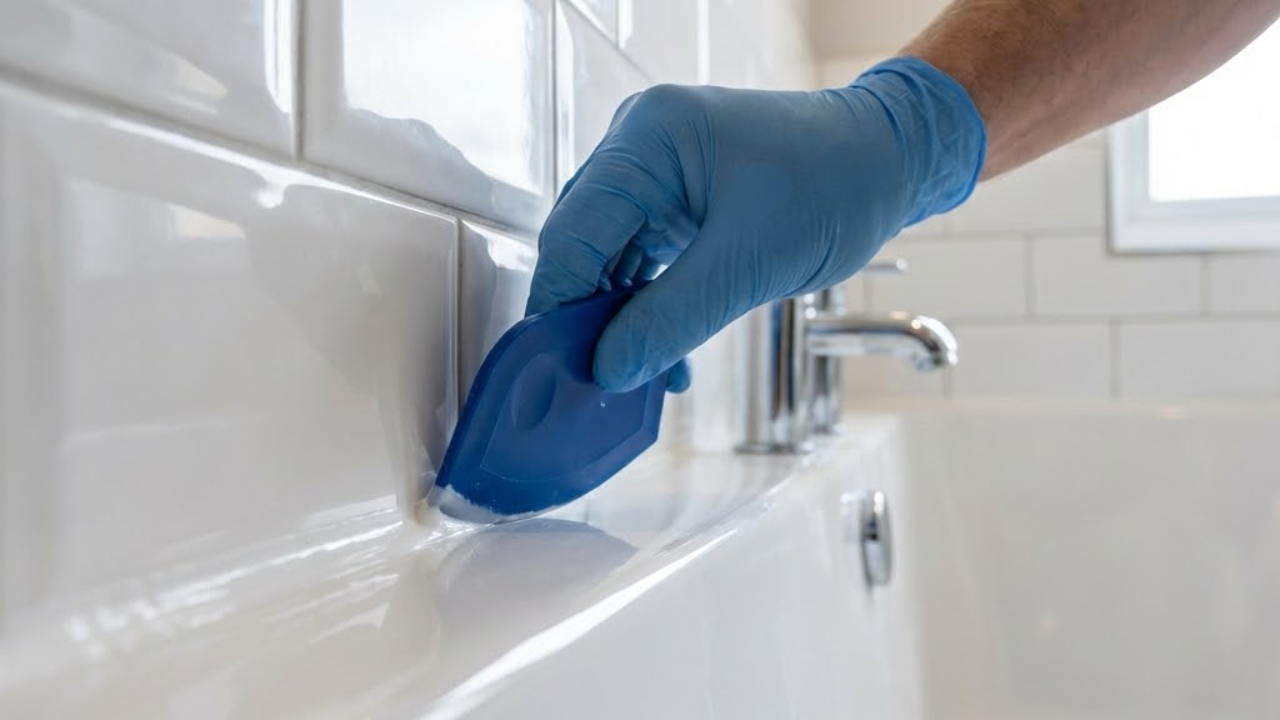
Tooling creates the final profile and ensures good contact with both surfaces. Do this immediately after application, before the sealant starts to skin over. Use a proper silicone tool or a gloved finger dipped in soapy water. Draw the tool along the joint in one smooth movement, applying consistent pressure to push the sealant into the joint and create a neat concave profile. Remove the masking tape immediately after tooling, pulling at a 45-degree angle away from the fresh sealant.
Common Installation Mistakes
Failed seals nearly always trace back to one of these errors.
Sealing over old sealant is the most common mistake. Silicone won't bond to silicone, no matter what the packaging claims. You must remove every trace of old sealant before applying new material. This takes time and effort, but there's no shortcut. Any areas where new sealant bridges over old will fail within months.
Inadequate surface preparation is a close second. A dusty tile edge or a greasy worktop will prevent proper adhesion. The sealant might look fine initially, but it'll peel away from the substrate as soon as it's stressed. Spend the time cleaning properly. It's faster than coming back to redo the job.
Wrong product selection causes failures that appear weeks or months later. Using acetoxy-cure silicone on natural stone will cause staining that can't be removed. Using general-purpose silicone in a shower will result in black mould growth. Using a low-movement sealant in a high-stress joint will lead to cracking and peeling. Read the technical datasheet and match the product to the application.
Insufficient curing time before exposing the seal to water is particularly common in occupied properties where the customer is pushing to use the facility. Most bathroom silicones need at least 24 hours before water exposure, and preferably longer for full cure. Using a shower 12 hours after sealing might seem fine initially, but the sealant hasn't developed full adhesion or chemical resistance yet, and premature water exposure can compromise the bond.
Overfilling joints wastes material and creates problems. An excessively thick bead takes longer to cure, is more prone to sagging, and may not cure completely in the centre. It also looks unprofessional. Use backing rod or tape to control joint depth and ensure the sealant cures properly throughout its thickness.
On a hotel bathroom refurbishment project, a subcontractor used acetoxy-cure silicone around marble vanity tops to save a few pounds. Within two weeks, dark acid staining appeared around every joint. The marble couldn't be cleaned, and 47 vanity tops required replacement at a cost of £18,000. The contractor absorbed the cost, lost the client relationship, and learned an expensive lesson about specifying the correct product.
Maintenance and Longevity
Even the best installation requires proper maintenance to achieve its full service life.
Regular cleaning with appropriate products extends sealant life significantly. Use pH-neutral bathroom cleaners rather than harsh bleach or acidic descalers that can degrade the sealant over time. Abrasive cleaners will damage the surface and create rough spots where dirt and mould can colonise. A soft cloth and mild detergent are sufficient for routine cleaning.
Ventilation is critical for preventing mould growth. Even the best antimicrobial sealant can be overwhelmed if the bathroom never dries out. Encourage proper ventilation after showering or bathing. Extractor fans should run for at least 20 minutes after water use, and windows should be opened when possible. Standing water and constant high humidity create conditions where even treated silicone will eventually support mould growth.
Inspection should be part of routine maintenance. Look for signs of adhesion loss, cracking, or mould penetration. Catching problems early allows for localised repairs before water damage occurs. Check joints around baths and shower trays particularly carefully. These are the highest-risk areas.
Expected service life for quality bathroom silicone in a well-maintained installation is typically 10-15 years. Kitchen applications may last longer due to less constant water exposure. However, this assumes proper installation, appropriate product selection, and reasonable maintenance. Poor installation might fail within months; excellent installation with cheap product might last 3-5 years.
Product Selection Guidance
When you're standing in front of the sealant display or reviewing supplier catalogues, focus on these selection criteria.
Neutral-cure bathroom silicone should be your default choice for any wet area application. The additional cost over acetoxy products is minimal compared to the labour cost of your time on site, and the broader substrate compatibility eliminates the risk of incompatibility issues. Trade heating supplies stock professional-grade neutral-cure products suitable for both trade and demanding residential installations.
Colour matching matters more than many installers realise. A poorly matched sealant colour draws attention to joints and makes the installation look cheap. Most manufacturers offer ranges that coordinate with popular grout colours. For natural stone or high-end installations, consider clear silicone, though be aware it shows dirt more readily and requires more frequent cleaning.
Low-modulus formulations are preferable for applications involving flexible substrates or significant movement. They require less force to stretch and compress, which reduces stress on the bond line. High-modulus sealants are stronger but less forgiving of movement and substrate flex.
Antimicrobial additives are essential for bathroom applications. Don't compromise here. The difference between a product with and without fungicide is dramatic in permanently wet environments. The antimicrobial package should be built into the silicone chemistry rather than applied as a surface treatment, ensuring long-term protection.
For commercial installations or projects where you're specifying products rather than just installing them, request technical datasheets and test certificates. Look for products tested to relevant standards for adhesion, movement capability, and fungal resistance. Quality manufacturers provide comprehensive technical support and will help you select the right product for challenging applications.
Troubleshooting Failed Seals
Understanding why seals fail helps you avoid repeating the same mistakes and provides insight when you're called back to address problems.
Adhesion failure where the sealant pulls cleanly away from one or both surfaces indicates contamination or incompatibility. If the sealant releases from the substrate with no residue left behind, the surface wasn't properly prepared or the product wasn't compatible with that material. This requires complete removal and proper surface preparation before resealing.
Cohesive failure where the sealant tears through the middle rather than releasing from the surfaces suggests the joint was oversized, the sealant was poor quality, or movement exceeded the product's capability. Check the joint width and depth, and consider whether a higher-movement product is needed.
Mould growth through the sealant rather than just on the surface indicates either the wrong product was used (general-purpose rather than bathroom-grade) or the antimicrobial additives have been exhausted. In constantly wet, poorly ventilated environments, even good bathroom silicone will eventually support mould growth. Address ventilation issues before resealing, or the problem will recur.
Cracking or splitting suggests insufficient movement capability for the application. This is common when acetoxy silicones are used in high-movement joints or when low-grade products are used in demanding applications. Upgrade to a higher-quality, higher-movement product for the replacement.
If you're facing repeated failures in a particular location, step back and analyse the joint design and conditions. Some situations require engineering solutions beyond just better sealant. Expansion joints, different substrate materials, or addressing underlying movement issues in the structure. When connecting systems with Grundfos circulators, Gledhill hot water cylinders, or Honeywell heating controls in wet areas, ensure sealant selection maintains equipment warranty compliance. For technical support on challenging applications, get expert advice for product recommendations and application guidance.
Conclusion
Silicone sealant selection and application in wet areas is fundamental to long-term installation success. The difference between a seal that lasts 15 years and one that fails within months comes down to choosing the right product for the specific application, preparing surfaces properly, applying the material with correct technique, and ensuring adequate curing before water exposure.
Neutral-cure bathroom silicones offer the best combination of substrate compatibility, movement capability, and mould resistance for most applications. They cost slightly more than basic acetoxy products but eliminate compatibility concerns and deliver superior long-term performance. Proper surface preparation and application technique matter more than brand selection. Even premium sealants will fail if applied to contaminated surfaces or without adequate joint design.
For trade professionals, investing time in understanding sealant chemistry and application best practices pays dividends in reduced callbacks, satisfied customers, and professional reputation. The techniques outlined here (loading baths and shower trays before sealing, using backing rod to control joint depth, cleaning surfaces with isopropyl alcohol, and tooling immediately after application) separate professional results from amateur work. Master these fundamentals, and you'll deliver watertight installations that protect your customers' properties and your professional reputation for years to come.