

Solid Wall Insulation and Heating System Sizing
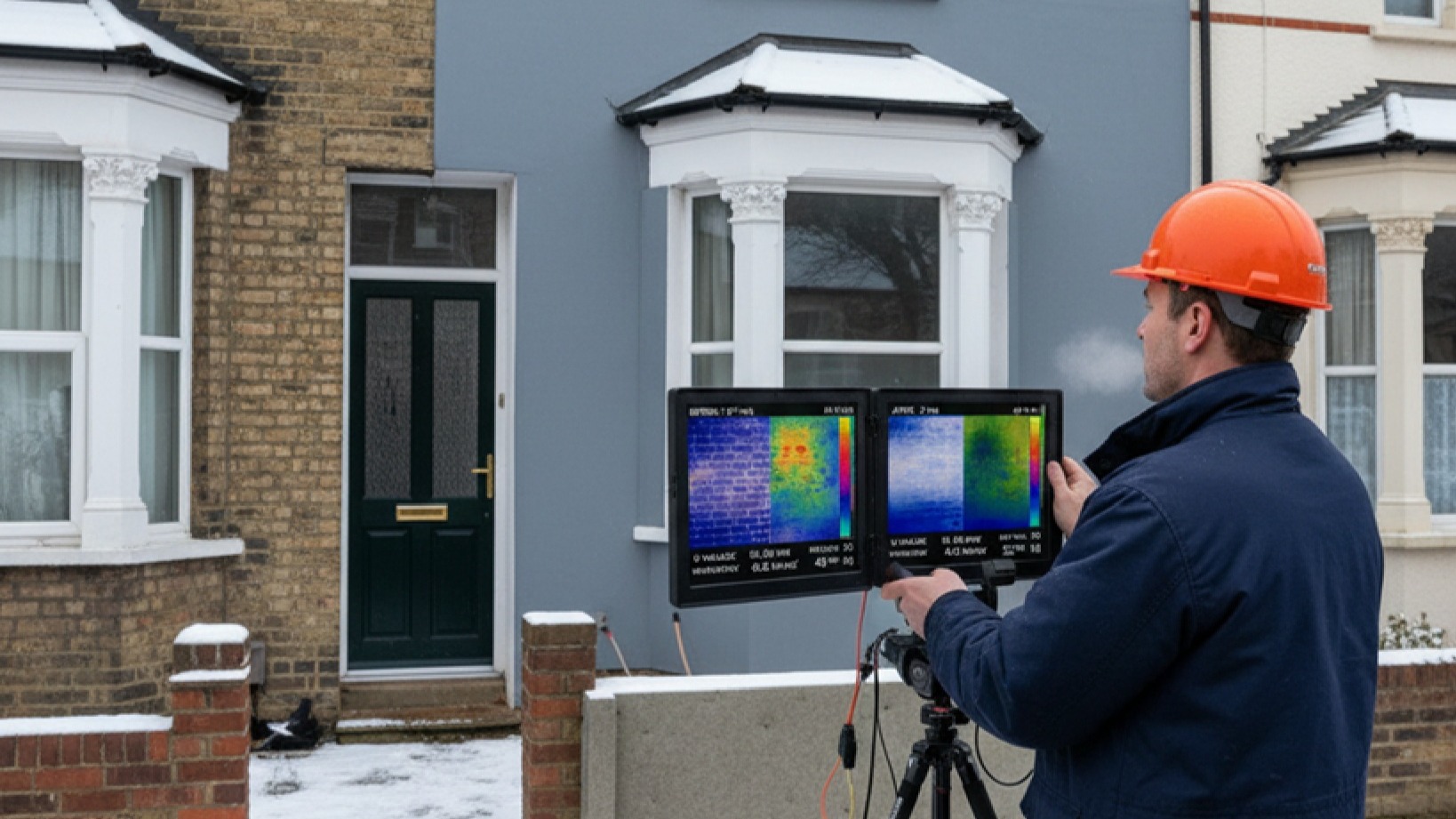
Installing solid wall insulation changes everything about how your heating system needs to work. The reduction in heat loss is so dramatic, typically 45-55%, that continuing to run the same boiler at the same settings wastes energy and money, resulting in poor comfort.
Homeowners invest £8,000-14,000 in external or internal wall insulation, then wonder why their heating bills haven't dropped as much as expected. The insulation works perfectly. The problem is that the solid wall heating system hasn't been reconfigured to match the building's new thermal performance.
Why Heat Loss Calculations Change After Insulation
Solid walls lose heat at roughly 2.1 W/m²K. Add 100mm of external insulation, and that drops to 0.35 W/m²K, an 83% reduction in heat transfer through the walls.
Before insulation: Wall heat loss of approximately 8,500W at design conditions
After insulation: Wall heat loss of approximately 1,400W at design conditions
That 7,100W difference represents roughly 40-50% of the total heat loss for most solid-walled homes, since walls are the primary thermal weakness in pre-1930s construction.
Your heating system doesn't automatically adjust for this. The boiler still fires at the same rate. The radiators still emit the same heat output. You're now pumping significantly more heat into the building than it loses, which creates three specific problems:
Cycling losses: The boiler reaches temperature quickly, shuts down, cools, then fires again. Each start-up cycle wastes energy and increases wear.
Flow temperature mismatch: Running 70-75°C flow temperatures when the building only needs 45-50°C reduces boiler efficiency by 15-20% if you have a condensing boiler.
Comfort issues: Rooms overheat quickly, thermostats shut the system down, then temperatures drop too far before heating restarts.
Calculating Your New Heat Requirement
Before resizing anything, you need accurate numbers. The whole-house heat loss calculation changes in every room that has gained insulation.
Example calculation for a typical Victorian terrace:
- Front wall: 8m × 5m = 40m² (minus 8m² of windows = 32m²)
- Rear wall: 8m × 5m = 40m² (minus 10m² of doors and windows = 30m²)
- Side gable: 8m × 3m (average) = 24m²
- Total external wall: 86m²
Before insulation at 2.1 W/m²K, with a 21°C internal and -3°C external design temperature (24°C difference): 86m² × 2.1 × 24 = 4,334W from walls alone
After 100mm EPS insulation at 0.35 W/m²K: 86m² × 0.35 × 24 = 722W from walls
You've cut wall losses by 3,612W. Add this to the unchanged losses from the roof (if already insulated), floor, windows, doors, and ventilation to get your new total heat requirement.
Most solid-walled homes need 12-15kW before insulation, after comprehensive solid wall insulation heating, which typically drops to 7-10kW.
Boiler Sizing: Smaller Isn't Always Better
The instinct is to replace your 24kW boiler with a 12kW model. Don't, at least not without considering hot water demand.
Modern combination boilers need roughly 24-28kW output to deliver 10-12 litres per minute of hot water at 40°C. If you downsize to a 12kW combi for space heating, you'll get perhaps 5-6 litres per minute, barely adequate for a single shower.
Three Effective Approaches
System or regular boiler with cylinder: Size the boiler for space heating demand only (7-10kW), and use an immersion heater or solar thermal for hot water. This maximises heating efficiency but requires space for a cylinder.
Modulating combi with wide range: Specify a boiler that modulates down to 3-4kW but can deliver 24kW+ for hot water. Models from manufacturers like Andrews or Halstead can handle both requirements effectively.
Right-sized system boiler: A 12-15kW system boiler with a 150-180L cylinder gives you efficient space heating and adequate stored hot water. The cylinder recovery time increases slightly, but modern heating controls can schedule hot water heating during off-peak periods.
The third option is typically recommended for post-insulation retrofits. The upfront cost is higher, £3,500-4,500 installed versus £2,800-3,500 for a combi, but the long-term efficiency gains justify it when you've already invested in solid wall insulation heating improvements.
Radiator Sizing and Flow Temperatures
Your existing radiators are oversized after insulation. That's actually perfect for running low-temperature heating.
Standard radiators are rated at ΔT50, a 50°C difference between the mean water temperature and the room temperature. If you want 20°C room temperature, that means 70°C flow and 60°C return (average 65°C).
Lower Temperature Operation
A 2,000W radiator at different temperature differentials:
- ΔT50: 70°C flow, 60°C return = 2,000W (100% rated output)
- ΔT30: 50°C flow, 40°C return = 1,240W (62% of rated output)
- ΔT25: 47.5°C flow, 37.5°C return = 1,040W (52% of rated output)
Before insulation, a room might need 1,800W, requiring a 2,000W radiator at ΔT50. After insulation, the same room needs 900W. That 2,000W radiator delivers 1,240W at ΔT30, still more than enough, but now running at 45°C mean temperature instead of 65°C.
This 20°C reduction in flow temperature increases condensing boiler efficiency from approximately 88% to 96-98%. For a home using 12,000kWh annually for heating, that's 960-1,200kWh saved, worth £250-300 at current gas prices.
Don't replace radiators unless they're corroded or you're changing room layouts. Oversized radiators enable low-temperature operation, which is exactly what you want.
Weather Compensation Controls
Fixed heating curves waste the efficiency gains from insulation. Weather compensation adjusts flow temperature based on outdoor temperature, ensuring the system delivers exactly the heat the building needs.
The control uses an outdoor sensor and adjusts boiler flow temperature according to a heating curve. When it's -3°C outside, the system might run at 50°C flow; when it's 10°C outside, the flow temperature drops to 35°C.
Typical Weather Compensation Curve
- Outdoor -3°C: Flow 50°C
- Outdoor 5°C: Flow 40°C
- Outdoor 10°C: Flow 35°C
- Outdoor 15°C: Flow 30°C (heating barely needed)
Compare this to a traditional on/off thermostat, which runs the boiler at 70°C regardless of outdoor temperature, cycling on and off as the room overshoots and undershoots the setpoint.
Weather compensation systems cost £300-600 for the controller plus £200-400 for installation. Most modern boilers have the capability built in; you're just adding the outdoor sensor and configuring the curve. Honeywell and Danfoss both manufacture weather compensation controls suitable for retrofit applications.
The efficiency gain is 8-12% compared to basic thermostat control, but only if your building envelope is good enough to benefit from low-temperature operation. Before insulation, you need those high-flow temperatures. After insulation, weather compensation controls become cost-effective.
Zoning and Room-by-Room Control
Solid wall insulation often gets installed room by room or floor by floor due to cost and disruption. This creates a mixed thermal performance building; some rooms need 60°C flow, others work fine at 40°C.
Zoning solves this. Split the heating system into separate zones with individual temperature control:
- Zone 1: Insulated rooms (bedrooms, rear extension)
- Zone 2: Uninsulated rooms (front reception, hallway)
Each zone gets its own programmable thermostat and zone valve. The boiler modulates to supply the temperature needed by the zone calling for heat. When only Zone 1 is active, flow temperature drops to 45°C. When Zone 2 calls for heat, it rises to 60°C.
The hardware costs £400-700 per zone (thermostat, zone valve, wiring, controls), but the efficiency gain can be significant if you're heating different thermal zones simultaneously. More importantly, it prevents the "cold room, hot room" problem where insulated spaces overheat while uninsulated ones stay cold.
For most homes, two zones are sufficient: living spaces and bedrooms. If you've insulated in phases, align zones with insulation stages. EPH Controls offers zone control systems specifically designed for retrofit applications.
Heat Pump Readiness
Installing solid wall insulation is the single most important step toward heat pump compatibility. The reduced heat demand and ability to run low-flow temperatures mean you're 80% of the way there.
Heat pumps operate most efficiently at 35-45°C flow temperatures. Before insulation, a solid-walled home needs 70°C+ flows on cold days, possible with a high-temperature heat pump, but at significantly reduced efficiency (COP of 2.0-2.5 versus 3.5-4.0 at lower temperatures).
After insulation, your oversized radiators can deliver adequate heat at 40-45°C flow, which is the sweet spot for air source heat pumps. A properly specified system can achieve a COP of 3.5-4.0 across most of the heating season.
The heat loss calculation you performed for boiler sizing applies directly to heat pump sizing. That 7-10kW heat requirement translates to a 7-10kW heat pump, though most installers will specify 10-12kW to account for defrost cycles and efficiency losses at low outdoor temperatures.
You don't need to install a heat pump immediately after insulation. But by right-sizing your radiators and controls for low-temperature operation, you're making the eventual transition straightforward rather than requiring a complete system redesign.
Ventilation and Air Quality
Solid wall insulation dramatically improves airtightness. External insulation systems typically include renders or cladding that seal construction gaps. Internal insulation boards create an air barrier on the warm side of the wall.
This is thermally beneficial; you're not losing heat through air leakage, but it reduces natural ventilation. Pre-1930s solid-walled homes typically have air change rates of 1.5-2.0 ACH (air changes per hour) through construction gaps, chimneys, and poor-fitting windows. Post-insulation, this can drop to 0.5-0.8 ACH.
Below 0.5 ACH, you risk condensation and indoor air quality problems. The building can't dry out the moisture from cooking, bathing, and breathing quickly enough.
Two Effective Solutions
Trickle vents in windows: Provide controlled background ventilation of 5,000-8,000mm² equivalent area. These maintain 0.5-0.7 ACH during the prevention of uncontrolled draughts.
Mechanical ventilation with heat recovery (MVHR): Extracts stale air from bathrooms and kitchens, supplies fresh air to living spaces and bedrooms, and recovers 85-95% of the heat from extracted air. Systems cost £3,000-5,000 installed for a typical home.
MVHR makes sense if you're doing a comprehensive retrofit, insulation, windows, and airtightness detailing. For standard solid wall insulation projects, trickle vents plus bathroom extractor fans provide adequate ventilation at minimal cost.
The heating system sizing needs to account for ventilation heat loss. At 0.5 ACH, a 120m³ home loses approximately 700W at design conditions. At 1.0 ACH, that doubles to 1,400W. Factor this into your heat loss calculation based on your actual ventilation strategy.
Measuring Actual Performance
Commission the system properly, then measure actual performance over the first heating season. You're looking for three indicators:
Boiler cycling: Count how many times the boiler fires per hour during moderate weather (8-12°C outdoor temperature). More than 4-5 cycles per hour suggests the system is oversized or the heating curve needs adjustment.
Flow temperatures: Log flow and return temperatures over a week. If you're consistently running above 55°C flow when outdoor temperatures are above 5°C, your heating curve is too aggressive.
Room temperatures: Use wireless temperature sensors in each room. Variations greater than 2°C between rooms indicate balancing issues or zoning problems.
Most modern boilers include diagnostics that log this data. Access the service menu and review minimum modulation rate, number of burner starts, and average flow temperature. Heating system diagnostics should be part of the annual service.
If the numbers don't match expectations, adjust the heating curve first; it's free and often solves 80% of comfort and efficiency issues. If problems persist, consider adding zone control or upgrading to weather compensation if you don't already have it.
Optimising System Performance
Solid wall insulation cuts heat loss by 45-55%, but your heating system won't automatically optimise for this change. The boiler continues firing at the same rate, radiators emit the same output, and controls follow the same logic, all sized for a building that no longer exists.
Recalculate your heat requirement using the new wall U-values. Most homes drop from 12-15kW to 7- 10kW total heat loss. Size your boiler for hot water demand if using a combi, or match space heating demand if installing a system boiler with a cylinder from manufacturers like Gledhill or Kingspan. Keep your existing radiators, they're now perfectly oversized for low-temperature operation.
Install weather compensation controls to adjust flow temperatures based on outdoor conditions. This captures 8-12% efficiency gains that fixed-temperature systems miss. If you've insulated in phases, add zoning to prevent overheating insulated rooms during underheating of uninsulated ones.
The result is a heating system that matches your building's new thermal performance: lower flow temperatures, reduced cycling, improved comfort, and 30-40% lower heating bills. You've paid for the insulation. Now configure the heating system to actually benefit from it.
Quality components make the difference in solid wall heating applications. Grundfos circulation pumps ensure consistent flow rates for low-temperature operation, whilst reliable pipework connections using professional copper fittings maintain system integrity. For comprehensive guidance on system components suitable for post-insulation heating upgrades, Heating and Plumbing World stocks the professional-grade equipment required. For technical advice on optimising your specific installation, contact experienced heating specialists who understand the unique requirements of solid wall insulation heating systems.