

Sports Centre and Leisure Facility Heating Systems
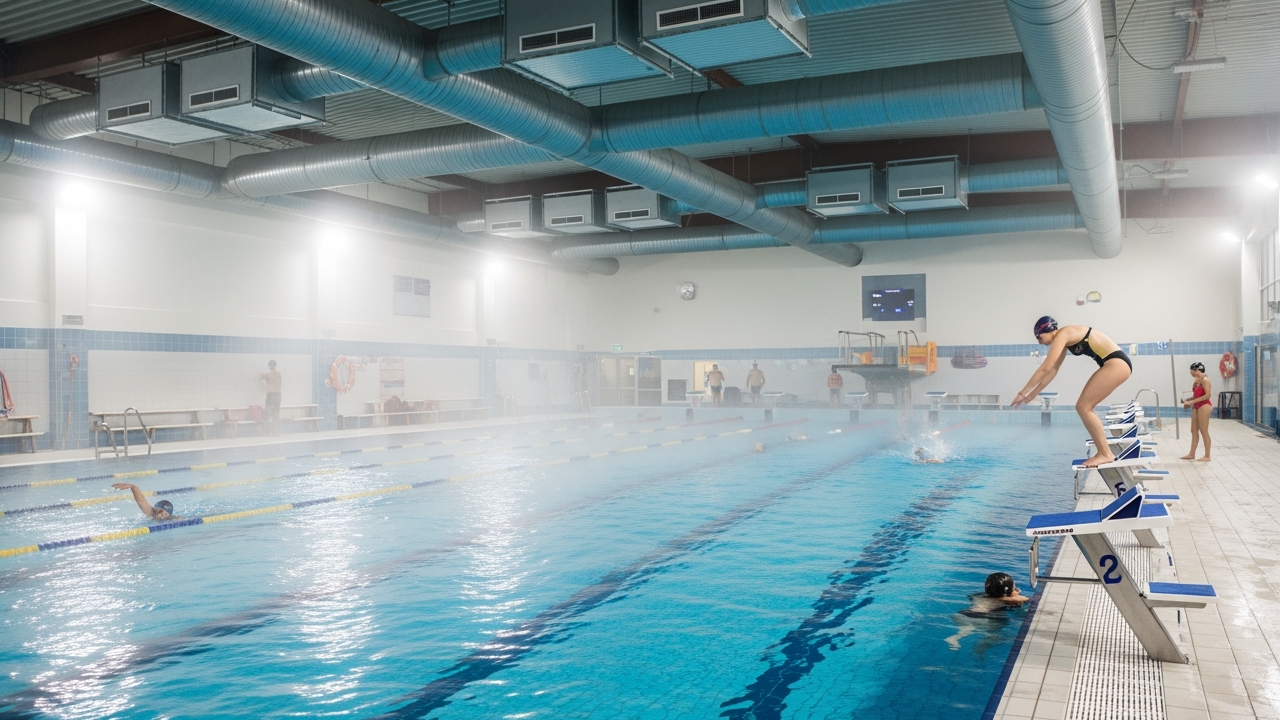
Sports centres operate under thermal demands that most commercial buildings never face. A swimming pool loses 70% of its heat through evaporation alone. A squash court generates temperature spikes of 8-12°C during peak use. A weight room needs different conditions than a yoga studio, yet both sit in the same building envelope.
Sports centre heating systems installed and maintained across leisure facilities reveal a clear pattern: generic HVAC solutions create energy waste, comfort complaints, and maintenance headaches. Purpose-built systems designed for the unique loads of sports environments consistently outperform standard commercial installations by 30-40% on efficiency metrics.
Why Standard Commercial Heating Fails in Sports Facilities
Most commercial heating systems assume relatively stable occupancy, predictable loads, and uniform space requirements. Sports centres violate all three assumptions.
A typical leisure facility combines wet areas (pools, saunas, steam rooms), high-activity zones (courts, fitness areas), and standard spaces (reception, cafés) within one building. Pool halls require 28-30°C air temperature with precise humidity control. Changing rooms need rapid recovery after cold outdoor air enters. Sports halls must handle 200+ people generating metabolic heat for one hour, then sit empty the next.
Standard systems respond to these variables too slowly. Measurements show 45-minute lag times between occupancy changes and temperature adjustment in facilities using conventional boiler systems with basic controls. During that lag, the system either overheats an empty space or leaves users uncomfortable.
The energy cost is measurable. A 25m pool facility in Hampshire reduced heating costs by £18,000 annually after switching from a standard gas boiler setup to a combined heat pump and condensing boiler system with zone-specific controls. The difference wasn't the equipment quality; the original system was well-specified. The difference was matching system architecture to actual thermal behaviour.
Heat Pump Systems for Pool Halls and Wet Areas
Pool environments present the most demanding heating scenario in leisure facilities. Water evaporation removes approximately 2,400 kJ per kilogram of water, roughly the energy needed to heat that same kilogram from freezing to boiling. A standard 25m pool loses 50-70 litres per hour to evaporation during use.
Air source heat pumps designed for pool applications recover this energy from exhaust air. The system captures warm, humid air from the pool hall, extracts the latent heat through refrigerant compression, and returns dehumidified air at the target temperature. Properly sized systems achieve Coefficient of Performance (COP) values of 4.5-5.5, meaning every 1 kW of electrical input delivers 4.5-5.5 kW of useful heating.
Pool-specific heat pumps with titanium heat exchangers for chlorine resistance and variable-speed compressors for load matching provide optimal performance. Fixed-speed units cycle on and off repeatedly, which reduces lifespan and creates temperature swings. Variable-speed operation maintains steady conditions whilst consuming 25-30% less energy.
The critical specification point is dehumidification capacity. Systems must remove moisture as fast as it's generated, or condensation forms on cold surfaces, windows, walls, and structural elements. Required capacity calculations based on pool surface area, water temperature, air temperature, and expected occupancy determine proper sizing. A system undersized by just 20% creates chronic condensation problems that damage building fabric and require expensive remediation.
Integration with pool heating systems requires careful hydraulic design. The heat pump should pre-heat pool water, with a backup boiler handling peak loads and providing redundancy during maintenance periods. Heating and Plumbing World supplies heat pumps and boiler equipment from manufacturers like Gledhill that meet commercial pool specifications.
Zoned Heating for Multi-Use Sports Halls
Sports halls present the opposite challenge to pools: rapidly changing loads rather than constant high demand. A badminton session generates minimal metabolic heat. A five-a-side football match with 20 players produces 3-4 kW of heat per person, 80 kW total for the space.
Effective leisure centre heating systems divide the hall into thermal zones controlled independently. Typical specifications include 3-4 zones for a standard four-court hall, with separate control for spectator areas. Each zone has its own temperature sensor and motorised valve controlling flow from the central plant.
Radiant heating panels mounted at a high level work better than forced air in high-ceiling sports halls. Radiant systems heat surfaces and people directly rather than warming air volume. This matters in spaces with 8-12m ceilings where stratification sends warm air to the roof. A radiant system can maintain 15°C at floor level whilst air temperature at ceiling height sits at 10°C, comfortable for users, impossible with convection heating.
Low-temperature radiant panels (operating at 50-60°C) fed by condensing boilers provide optimal results. Lower flow temperatures improve boiler efficiency from 85% to 95%+ and reduce radiant intensity to comfortable levels. High-intensity radiant heaters (operating above 100°C) create hot spots and uneven heating patterns that generate complaints.
Control systems must anticipate use rather than react to it. Heating schedules programmed based on booking systems bring zones up to temperature 30-45 minutes before scheduled use. This pre-heating approach maintains comfort whilst reducing average operating temperature; the space doesn't need to stay at 15°C overnight if it can reach that temperature before the 7 am badminton booking. Advanced control systems from manufacturers like Danfoss enable this level of precision.
Underfloor Heating for Changing Rooms and Circulation Spaces
Changing rooms cycle between empty and occupied every 30-45 minutes during peak periods. Each cycle introduces cold outdoor air as users enter, then requires rapid heating to maintain comfort while people shower and change.
Underfloor heating provides thermal mass that buffers these fluctuations. The concrete slab stores heat during low-demand periods and releases it during occupancy spikes. Specifications of 100-150mm screed depth with 16mm pipe at 150mm centres work well for changing room applications.
The system requires careful control to avoid overheating. Underfloor systems respond slowly; changes to flow temperature take 2-3 hours to affect room temperature. Weather compensation controls that adjust flow temperature based on outdoor conditions and time-based programming that reduces output during closed hours provide the necessary precision.
Mixing valves are essential. Underfloor systems operate at 35-45°C flow temperature, whilst the primary boiler circuit runs at 70-80°C. The mixing valve blends return water with flow water to achieve the target temperature. Actuated mixing valves with electronic controls rather than thermostatic valves provide the precision needed in applications where 2-3°C makes the difference between comfort and complaints.
Circulation spaces, corridors, entrance halls, and reception areas benefit from the same approach. These areas experience constant door opening during operating hours, creating cold draughts that conventional radiators can't counteract effectively. Underfloor heating maintains floor surface temperature at 23-25°C, which eliminates the perception of cold even when air temperature drops temporarily.
For facilities concerned about installation cost, electric underfloor heating offers a lower capital cost alternative in smaller changing rooms, though operating costs are higher than water-based systems.
Primary Plant Design and System Integration
Sports centre heating systems require more sophisticated primary plant design than standard commercial buildings. The combination of constant high loads (pools), variable loads (sports halls), and buffer loads (changing rooms) creates demand patterns that simple boiler installations can't handle efficiently.
Heat pumps make sense for facilities with high summer cooling loads. A reversible heat pump provides heating in winter and cooling in summer, improving year-round efficiency. The capital cost premium (40-60% more than boiler-only systems) amortises over 7-10 years through reduced operating costs in most applications.
Buffer vessels are critical for systems serving multiple zones with different demand patterns. Specifications of 1,000-2,000 litre buffer tanks between the boiler plant and distribution circuits prove effective. The buffer absorbs short-term load variations, preventing rapid boiler cycling and extending equipment life. A properly sized buffer reduces boiler starts by 60-70%, which directly correlates with maintenance costs and reliability. Commercial-grade pumps from Grundfos and Lowara provide the reliability needed in these demanding applications.
Control systems should integrate with building management systems (BMS) to enable remote monitoring and adjustment. Remote diagnosis and resolution of heating issues often occur before staff notice problems. The BMS tracks boiler run hours, efficiency metrics, zone temperatures, and fault conditions. This data drives preventive maintenance scheduling and identifies performance degradation before failures occur.
Energy Recovery and Waste Heat Utilisation
Sports facilities generate significant waste heat that standard designs ignore. Shower water at 38-40°C goes straight to the drain. Pool backwash water at 28°C is discarded. Refrigeration systems in ice rinks and cold stores reject heat continuously.
Drain water heat recovery systems capture 40-60% of the heat from shower and pool water. The systems use heat exchangers in the drainage pipe to pre-heat incoming cold water. A facility with 20 showers running 8 hours daily can recover 15,000-20,000 kWh annually, worth £1,500-2,000 at current energy prices.
Vertical heat recovery units installed in drainage stacks provide optimal performance. These units require no pumps or controls; they operate passively as water flows through them. The payback period is typically 3-5 years, shorter if installed during new construction when drainage routing can be optimised.
Ice rink facilities offer larger recovery opportunities. The refrigeration system that keeps ice frozen rejects heat continuously; a standard ice pad produces 150-200 kW of waste heat during operation. Heat recovery chillers capture this energy for space heating, domestic hot water, or ice resurfacing water heating. Facilities that implement heat recovery reduce heating costs by 40-50%.
The integration requires careful design. The refrigeration system must maintain ice temperature regardless of heating demand, so recovered heat supplements rather than replace the conventional heating plant. System designs with thermal storage buffer the mismatch between when heat is available (during ice maintenance and events) and when it's needed (early morning warm-up periods).
For facilities installing new commercial boiler systems, heat recovery should be specified from the start rather than retrofitted later. The incremental cost during construction is 30-40% lower than the retrofit installation.
Maintenance Requirements and Life-Cycle Costs
Sports centre heating systems operate longer hours and face harsher conditions than typical commercial installations. Pool environments expose equipment to chlorinated air. Sports halls experience dust and impact damage. High usage means components reach end-of-life faster.
Quarterly maintenance visits for critical systems (pool heating, primary plant) and annual service for secondary systems (changing room heating, perimeter heating) provide appropriate coverage. The quarterly schedule catches developing issues, pump bearings wearing, heat exchanger scaling, and control valve sticking before they cause failures.
Water treatment is non-negotiable for closed-loop heating systems. Untreated water causes corrosion, scale buildup, and microbial growth. Inhibitor dosing systems that maintain pH between 7.5 and 8.5 and provide corrosion protection deliver reliable results. Annual water testing verifies treatment effectiveness. The cost of proper treatment (£300-500 annually for a typical facility) is trivial compared to heat exchanger replacement (£8,000-15,000) or boiler failure (£25,000-40,000).
Component selection affects long-term costs significantly. Commercial-grade pumps with sealed bearings and stainless steel shafts for pool applications cost 40-50% more than standard pumps but last 12-15 years versus 5-7 years for standard equipment. Over a 20-year facility life, the premium-grade pumps cost less and require fewer disruptive replacements.
Control systems require firmware updates and recalibration. Temperature sensors drift over time; a 2°C calibration error causes 10-15% efficiency loss. Sensor verification in annual maintenance and sensor replacement on a 5-year cycle, regardless of apparent function, maintains system accuracy.
Documentation is critical for facilities with multiple maintenance providers or staff turnover. Comprehensive system documentation, including hydraulic schematics, control sequences, equipment specifications, and maintenance schedules, enables any competent contractor to maintain the system effectively. Facilities aren't locked into a single service provider.
Performance Data from Leisure Facilities
A 3,000m² leisure centre in Somerset with a 25m pool, sports hall, fitness suite, and changing facilities switched from a 20-year-old boiler system to an integrated heat pump and condensing boiler design in 2021. The facility tracked energy consumption for 24 months post-installation.
Results showed 38% reduction in heating energy consumption (from 1,240 MWh annually to 770 MWh) despite a 12% increase in opening hours. Gas consumption dropped 52%, partially offset by increased electricity use for heat pumps. At 2023 energy prices, annual savings totalled £32,000. The system cost £185,000 installed, giving a 5.8-year simple payback.
More importantly, the facility eliminated the temperature complaints that averaged 15-20 per month under the old system. The new zoned approach maintains different areas at appropriate temperatures automatically. Staff no longer manually adjust radiator valves or field complaints about cold changing rooms.
A university sports centre in Scotland implemented drain water heat recovery across 32 showers in 2020. The installation cost £18,000. Metering showed 17,200 kWh annual heat recovery, saving £1,890 yearly. The 9.5-year payback was longer than projected due to lower-than-expected shower usage during pandemic closures, but the system now performs to original specifications.
Conclusion
Sports centre heating systems succeed or fail based on how well they match the specific thermal characteristics of leisure environments. Pool halls need continuous dehumidification and heat recovery. Sports halls require a rapid response to changing loads. Changing rooms benefit from thermal mass and buffer capacity. Trying to serve all these needs with a single system approach creates inefficiency and comfort problems.
The facilities that achieve the lowest operating costs and highest user satisfaction share common features: zoned systems that treat different areas appropriately, heat recovery that captures waste energy, controls that anticipate demand rather than react to it, and plant design that provides redundancy for critical loads.
The capital cost premium for properly specified systems ranges from 25-40% above basic installations, but operating cost savings of 30-50% deliver payback in 4-7 years. Beyond financial returns, appropriate systems eliminate the comfort complaints and maintenance emergencies that disrupt operations and damage the facility's reputation.
For facilities planning new installations or replacing ageing systems, the investment in proper system design and quality components pays dividends throughout the 20-25 year system life. The alternative, installing inadequate systems that require constant adjustment, generate complaints, and consume excessive energy, costs far more over time, whilst delivering inferior results. For expert guidance on leisure centre heating specifications and equipment selection, contact us for tailored recommendations.