

Storing Boiler PCBs: Environmental Conditions For Spare Parts Stock
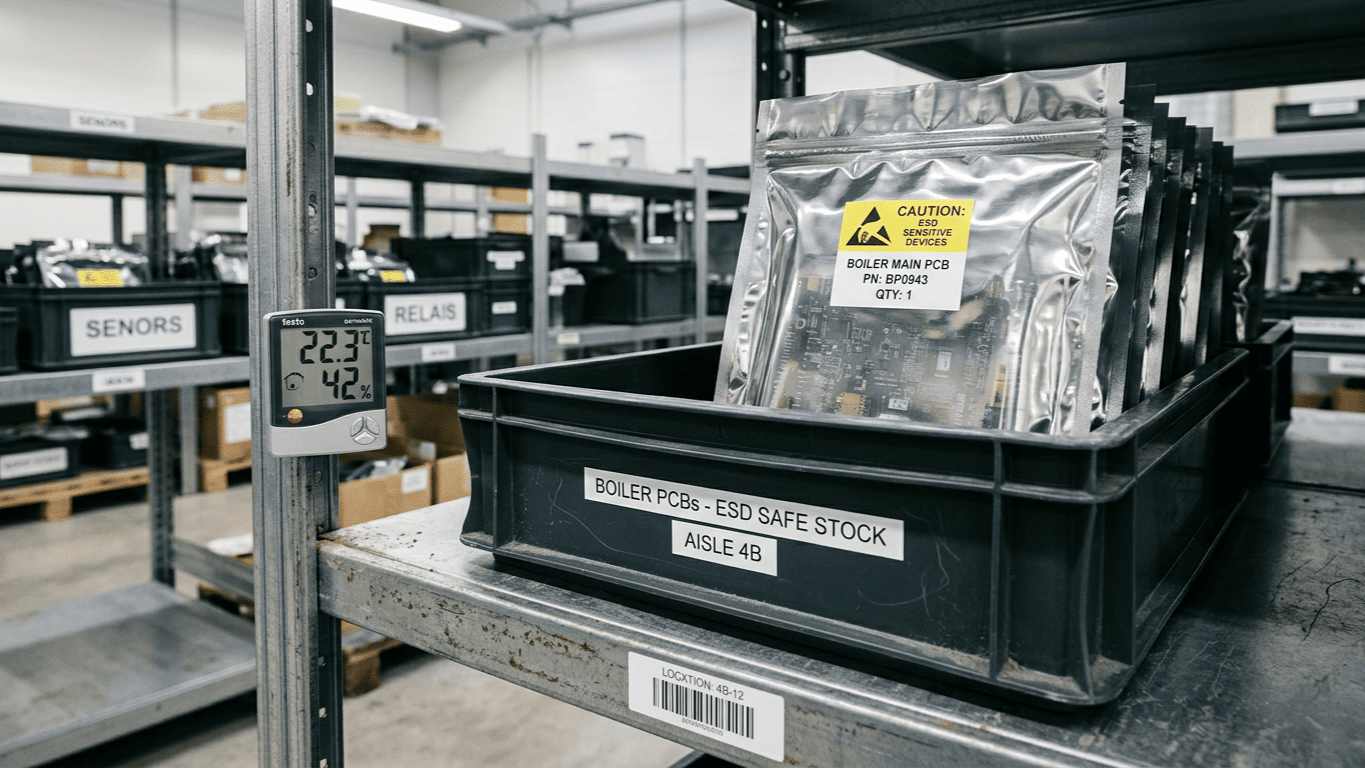
A boiler engineer I once worked with kept his spare PCBs in a leaky garden shed. Consequently, it cost him three thousand pounds before he worked out why half his stock was failing within weeks of installation. The boards looked perfectly fine on the shelf. However, it is what you cannot see that eventually kills them.
Printed circuit boards are not like copper fittings or standard thermostats. Instead, they are sensitive, temperamental bits of kit that respond badly to moisture, heat swings, and static electricity. If you store them wrong, you are essentially running a very expensive recycling operation. Most heating businesses hold some stock so they don't leave customers without heating.
Understanding the best practices for storing boiler PCBs is vital for any professional operation. Damage accumulates even when the boards are not being used. Therefore, you must manage your storage environment with the same precision you use for your installations. This protects your investment and ensures your customers aren't left in the cold.
Why PCBs Fail In Storage
Electronic components deteriorate silently over time even without power. Moisture is the primary killer because PCBs contain materials that absorb water from the air. Once moisture gets into the board, it causes hidden corrosion on the copper traces. You won't see it until you power the board up and it fails within hours.
At Heating and Plumbing World, we understand that temperature fluctuations also create expansion and contraction cycles. Different materials on the board expand at different rates. This eventually causes solder joints to crack. Furthermore, electrostatic discharge can destroy sensitive components instantly.
If you touch a board with a static charge, you might damage integrated circuits without any visible sign. Contamination from dust and oils also creates conductive paths where they shouldn't exist. A thin layer of dust mixed with condensation becomes a weak conductor. This causes short circuits or erratic behaviour. For instance, if you're storing a Worcester expansion vessel and a few PCBs, losing even one board to storage damage writes off hundreds of pounds in profit.
Optimal Temperature Range
PCBs need stable temperatures rather than cold ones. The sweet spot for storing boiler PCBs sits between 15°C and 25°C. Stability matters more than the absolute value. A board stored at a constant 20°C will outlast one that cycles between different temperatures daily.
Going below 10°C risks condensation when you move boards into a warm room. Think of a PCB like a cold bottle of soda taken out of a fridge on a hot day. Moisture immediately forms on the surface. Similarly, when a cold board meets a warm room, moisture seeps into the components.
Temperatures above 30°C are also dangerous. They accelerate chemical degradation in the board materials. For example, electrolytic capacitors have a failure rate that roughly doubles for every 10°C increase. A board stored at 35°C ages twice as fast as one stored at 25°C. Most office environments naturally maintain the right range, which is why a dedicated cupboard beats a van or a garage every time.
Humidity Control Requirements
Relative humidity between 30% and 50% provides the ideal storage environment. This range prevents both moisture absorption and static electricity buildup. If you are above 60% humidity, you are asking for trouble. Moisture penetrates the substrate and corrodes internal copper layers.
Conversely, very dry air below 30% humidity increases static electricity risks. Dry air allows static charges to build up more easily and discharge more violently. Using a digital hygrometer is the easiest way to monitor these levels. You can buy a digital hygrometer for under twenty pounds to protect thousands in stock.
The UK climate makes humidity control challenging. We regularly see outdoor levels above 70%, especially in autumn. For larger stock quantities, a dehumidifier in your storage area maintains stable conditions year-round. If you're consistently above the safe limit on your digital hygrometer, your storage conditions need immediate improvement.
Anti-Static Protection
Static electricity destroys electronic components permanently. You won't hear a bang or see a spark. Instead, the damage happens at a microscopic level. Electrostatic discharge can carry voltages exceeding 15,000 volts. Modern boiler PCBs contain circuits that fail with discharges as low as 100 volts.
Proper ESD-safe packaging is non-negotiable. There are two main types of protective bags. Anti-static bags prevent static buildup but don't shield against external charges. However, metallised static-shielding bags provide complete protection. You should always use metallised static-shielding bags for long-term storage.
Never remove boards from their original ESD-safe packaging until you're ready to install them. If you must repackage them, ensure you buy proper materials. Standard plastic bags or bubble wrap generate static electricity and should never be used. Using the right ESD-safe packaging ensures that electrostatic discharge doesn't ruin your inventory before it reaches the customer.
Storage Container Selection
The container you choose matters as much as the room itself. Sealed plastic boxes with proper lids work well. However, you should choose containers made from static-dissipative plastic. Standard household boxes generate static electricity. They are fine for Christmas decorations but not for expensive electronics.
Size the container appropriately for the boards. PCBs shouldn't rattle around loose. However, cramming them in tight risks physical damage. Allow enough space to store boards in their metallised static-shielding bags without crushing them. If you are storing larger items, like a Zilmet Hy-Pro vessel, keep them separate from the delicate electronics.
Opaque containers also protect against ultraviolet light. UV exposure breaks down the resins used in PCB construction. This leads to discolouration and eventual delamination of the board layers. Store your boards in dark locations or solid cupboards to prevent this cumulative damage.
Shelf Life And Stock Rotation
Even under perfect conditions, PCBs don't last indefinitely. Components age and materials degrade. For instance, electrolytic capacitors have the shortest shelf life. They often last between two and five years depending on the environment. A five-year-old board might have capacitors near the end of their life before you even install them.
Implementing a stock rotation system is the best way to manage this risk. Mark each board with the date you received it. Always use your oldest stock first. If you are holding boards for more than two years, you should question if you need that much inventory.
A reliable stock rotation system ensures you aren't installing degraded parts. Solder also oxidises over time, making joints more prone to failure. If you are stocking high-turnover parts like an Oxy-Pilot NG9040, rotation is easier. However, for expensive PCBs, you must be disciplined with your tracking.
Physical Protection Requirements
PCBs are mechanically fragile. The boards can crack and components can break off easily. Vibration damage also accumulates over time. Boards stored in vans or near heavy machinery experience constant low-level vibration. This gradually fatigues the solder joints.
Impact protection also matters during transport. A board dropped from waist height might show no visible damage. However, it could have cracked traces or fractured joints internally. Always handle boards carefully. Ensure your storage containers have adequate padding.
When you're moving a Bentone 90W burner motor or similar heavy equipment, keep it away from the PCB containers. Weight can compress and damage boards even inside their packaging. Tall components like transformers can also bend if the boards shift during transport.
Contamination Prevention
Clean storage environments extend PCB life significantly. Dust accumulation holds moisture against the board surface. It also provides a base for corrosion. A thin layer of dust mixed with condensation becomes a weak electrolyte.
Therefore, you should store PCBs in sealed containers rather than on open shelves. Chemical contamination from solvents or oils can also damage board materials. Don't store your electronics near paints or aerosol products. Vapours from these products can condense on the boards and cause insulation breakdown.
I once saw a workshop where the PCB shelf was right next to the bench where an engineer cleaned an Ecoflam gas burner. Fine oil mist and solvent vapours had coated the "new" boards in a sticky residue. Within six months, three of those boards failed in the field due to surface tracking and short circuits. It was a very expensive lesson in workshop layout.
Documentation And Tracking
Proper records help you identify storage problems before they become expensive. Log every board when it enters your stock. Record the model number, purchase date, and storage location. Note the manufacturer date code if it is visible on the board.
Regular inspections catch problems early. Check your stored boards monthly for signs of corrosion or package damage. Use your digital hygrometer to log the humidity weekly. If the readings drift outside the acceptable range, investigate the cause immediately.
Failure tracking also reveals patterns. If you see higher failure rates for a specific model, examine your storage conditions. Create a simple spreadsheet to track your stock rotation system. Review it monthly to identify any slow-moving stock that is approaching the end of its reliable life.
Conclusion
Properly storing boiler PCBs is not complicated, but it does require attention to detail. You need to maintain temperatures between 15°C and 25°C. Furthermore, keeping humidity between 30% and 50% is essential. If you get these basics right, your spare stock will be ready when you need it most.
The cost of proper storage is minimal compared to the cost of failed boards. A dehumidifier and some metallised static-shielding bags cost less than replacing a single damaged PCB. Make these procedures part of your standard daily practice.
Your spare parts stock represents significant working capital for your business. Protect that investment with the right environmental conditions. You will reduce waste, improve reliability, and keep your customers warm. If you need further advice on managing your technical stock or selecting the right components, be sure to get expert advice from our specialist team.