

Stuart Turner Shower Pumps: Product Range Comparison
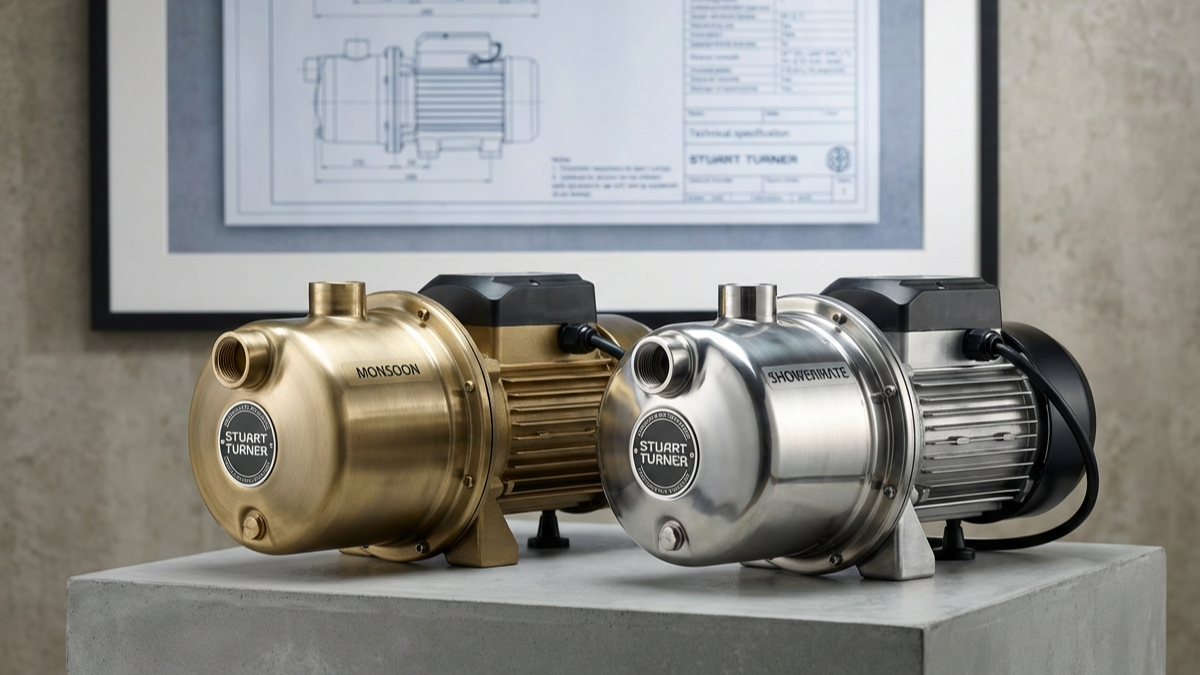
Stuart Turner has manufactured shower pumps in the UK since 1906, and their current range addresses specific water pressure problems across different property types. This comparison breaks down their product lines by technical specifications, installation requirements, and typical applications.
Understanding Stuart Turner's Core Product Categories
Stuart Turner pumps divide into three main categories: single-impeller pumps for positive head systems, twin-impeller pumps for negative head installations, and whole-house pumps that boost pressure throughout the property. Each category solves distinct pressure problems.
Single-impeller pumps work when your cold water tank sits above the shower outlet (positive head). The pump only needs to accelerate water that's already flowing by gravity. Twin-impeller pumps handle situations where the tank sits at the same level or below the shower (negative head), requiring the pump to both lift and accelerate the water. Whole-house pumps connect to the mains supply and boost pressure to all outlets simultaneously.
The technical distinction matters for installation: single-impeller pumps cost 30-40% less but require a minimum 150mm head (the vertical distance between tank base and pump inlet). Twin-impeller pumps work with zero head but consume more power and generate additional noise.
Monsoon Range: The Universal Solution
The Monsoon range represents Stuart Turner's most versatile product line, available in single and twin-impeller configurations across power outputs from 1.5 bar to 3.0 bar. Monsoon pumps feature in roughly 60% of residential projects because they handle both standard and thermostatic showers without additional components.
Monsoon Standard models (1.5 bar, 2.0 bar, 3.0 bar) suit conventional mixer showers and come in single or twin versions. The 2.0 bar twin-impeller pump shifts 46 litres per minute at full capacity, enough for two high-flow showerheads running simultaneously. These pumps measure 255mm × 195mm × 195mm and weigh 8.2kg, fitting inside standard airing cupboards without floor reinforcement.
Monsoon Universal models add compatibility with digital and thermostatic showers that use flow sensors. Standard pumps create pressure spikes that confuse these sensors, causing the shower to cut out intermittently. Universal models incorporate pressure vessels and non-return valves that smooth flow delivery. The trade-off: Universal pumps cost £80-120 more and require 100mm additional installation space for the pressure vessel.
The Monsoon range includes automatic air purge systems that clear trapped air during startup. Earlier Stuart Turner models required manual bleeding, a process that added 15-20 minutes to commissioning time and created callback situations when homeowners couldn't restart pumps after power cuts.
Showermate Range: Compact Solutions for Tight Spaces
Showermate pumps target installations where space constraints eliminate standard options. These pumps measure 40% smaller than equivalent Monsoon models; the Showermate S2.0 bar twin occupies just 180mm × 150mm × 180mm, allowing installation inside shower cubicle boxing or under bath panels.
The size reduction comes from higher-speed impellers and compact motor housings. This design choice creates two practical consequences: Showermate pumps generate 48-52 dB at one metre (compared to 42-46 dB for Monsoon equivalents), and motor bearings typically need replacement after 6-8 years versus 10-12 years for Monsoon pumps.
Showermate models suit single-shower installations where the pump can sit close to the outlet. The shorter pipe runs minimise the noise transmission that becomes problematic with these higher-frequency pumps. Showermate installations in properties where the pump must sit more than 3 metres from the shower should be avoided, as the noise becomes noticeable through wall cavities.
The range includes both positive head (Showermate S) and negative head (Showermate PN) configurations, with power outputs from 1.5 to 2.0 bar. Stuart Turner discontinued the 3.0 bar Showermate in 2019 after field reports showed accelerated bearing wear at higher speeds.
Flomate Mains Boost Pumps: Whole-House Pressure Solutions
Flomate pumps connect directly to the incoming mains supply, boosting pressure throughout the property without requiring cold water tanks. These systems work in new-build properties that lack loft space for traditional gravity-fed systems, or in renovations where homeowners want to remove header tanks.
Flomate Mains Boost 50 models suit properties with reasonable incoming pressure (1.0-1.5 bar) that need boosting to 2.5-3.5 bar. These pumps incorporate pressure switches that activate when taps open and shut off when they close. The switching mechanism creates a 1-2 second delay between opening a tap and reaching full pressure, noticeable but acceptable for most users.
Flomate Mains Boost 80 models handle properties with poor incoming pressure (0.5-1.0 bar), incorporating larger motors and multi-stage impellers. These pumps include 8-litre pressure vessels that maintain consistent pressure and reduce motor cycling. The vessels pre-charge to 1.5 bar, creating instant pressure when taps open and allowing the pump to run for longer intervals rather than constant start-stop cycles that reduce motor life.
Both Flomate ranges require minimum incoming flow rates: 12 litres per minute for the 50 series, 15 litres per minute for the 80 series. Properties with lower incoming flow need accumulator vessels, essentially buffer tanks that store boosted water and allow the pump to refill the vessel slowly whilst delivering high flow rates on demand.
Installation regulations require Flomate pumps to include Type AB air gaps or RPZ valves to prevent backflow contamination of mains water. These devices add £150-250 to installation costs but meet Water Supply Regulations 1999 requirements for mains-connected pumping systems.
Pump Power Ratings: Matching Output to Application
Stuart Turner shower pumps carry bar pressure ratings, but this specification only tells part of the performance story. Flow rate drops as resistance increases, a 2.0 bar pump delivers 46 litres per minute with zero resistance, but only 28 litres per minute through 10 metres of 15mm pipe with two 90-degree elbows.
1.5 bar pumps suit single showers with low-flow heads (8-10 litres per minute). These pumps handle standard mixer valves but lack the pressure for rainfall heads or body jets. Power consumption runs at 120-150 watts.
2.0 bar pumps represent the sweet spot for most residential installations, enough pressure for high-flow showerheads (12-15 litres per minute) without excessive power consumption (180-220 watts). These pumps supply two standard showers simultaneously or one shower with body jets.
3.0 bar pumps deliver commercial-grade performance for luxury shower systems with multiple outlets. Flow capacity reaches 55 litres per minute at full output, but power consumption jumps to 350-400 watts. These pumps require 16mm supply pipes to prevent cavitation, the formation of vapour bubbles that damage impellers and create rattling noises.
Installation Requirements That Affect Product Selection
Stuart Turner specifies minimum pipe sizes for each pump model, but actual requirements depend on pipe run length and fitting count. The 2.0 bar Monsoon technically works with 15mm supply pipes from Polypipe, but runs exceeding 5 metres need 22mm pipes to prevent flow restriction.
Single-impeller pumps need the pump body positioned below the cold water tank outlet, typically 150-600mm below. Twin-impeller pumps can sit at any level, but performance improves when the pump sits close to the tank level. Positioning the pump 2 metres below the tank with a twin-impeller model wastes the free gravity pressure and forces the pump to work harder.
All Stuart Turner pumps require Surrey flanges or equivalent anti-siphon devices on the cold tank. These flanges prevent the pump from draining the entire tank through the shower outlet if someone leaves the shower running. The flanges add £45-60 to parts costs but prevent water damage from tank drainage.
Electrical installation requires dedicated circuits with 3-amp fuses for pumps up to 2.0 bar, 5-amp fuses for 3.0 bar models. Flomate mains boost pumps need 10-amp circuits due to higher motor loads and startup current spikes. All pumps require double-pole isolation switches positioned outside the bathroom for emergency shutdown.
Noise Levels and Vibration Control
Stuart Turner publishes noise ratings at one metre distance in free air, but installed performance varies significantly based on mounting method and pipe installation. A pump rated at 44 dB can produce 58 dB in the bedroom below if mounted directly to floor joists without isolation.
Anti-vibration mounts reduce transmitted noise by 60-70%, the difference between hearing a low hum and hearing nothing. These mounts cost £25-40 but eliminate most callback complaints. Installation of these mounts on every pump, regardless of stated noise levels, proves worthwhile because structure-borne vibration carries further than airborne noise in residential construction.
Flexible hose connections on the inlet and outlet pipes prevent vibration transmission through the pipework. Rigid copper connections from suppliers like Fittings turn the entire pipe system into a resonator, amplifying pump noise throughout the property. The flexible hoses cost £18-25 per pair and take three minutes to fit, a minimal investment that solves major noise problems.
Monsoon pumps include rubber-mounted motors that isolate vibration within the pump body. Showermate pumps use rigid mounting to achieve compact dimensions, making external vibration isolation more critical for these models.
Warranty Coverage and Failure Patterns
Stuart Turner provides three-year warranties on Monsoon and Flomate pumps, two years on Showermate models. The warranty distinction reflects expected service life rather than quality differences; compact pumps simply work harder and wear faster.
Common failure modes differ by pump type. Single-impeller pumps typically fail from capacitor degradation (the component that helps start the motor), creating symptoms where the pump hums but doesn't run. Capacitor replacement costs £35-50 and takes 20 minutes. Twin-impeller pumps more commonly fail from bearing wear, creating grinding noises and reduced flow. Bearing replacement requires pump disassembly and costs £120-180, including labour.
Flomate pumps experience pressure switch failures after 4-6 years in hard water areas. Limescale buildup prevents the switch from activating reliably, causing the pump to run continuously or not start. Switch replacement costs £65-90, but the pump requires descaling during service to prevent recurrence.
Stuart Turner stocks spare parts for pumps manufactured within the last 15 years, allowing repair of most failures without complete replacement. This part's availability reduces lifetime ownership costs compared to manufacturers who discontinue parts support after 5-7 years.
Price Positioning and Value Comparison
Stuart Turner pumps occupy the mid-to-premium price segment: Monsoon 2.0 bar twin pumps retail around £380-420, whilst equivalent Grundfos models cost £420-480 and Salamander pumps run £340-380. The price differences reflect manufacturing location (Stuart Turner produces pumps in Henley-on-Thames) and component quality rather than performance gaps.
The value equation changes when considering installation requirements. Stuart Turner pumps include mounting brackets, isolation valves, and connection fittings in the box, components that cost £45-65 separately for some competing brands. The integrated accessories reduce installation time by 20-30 minutes, offsetting some price premium through reduced labour costs.
Showermate pumps cost 15-20% less than equivalent Monsoon models but require replacement sooner, making them cost-effective for short-term installations or rental properties where compact size justifies the trade-off. Flomate pumps cost significantly more (£650-850 for the Boost 50, £950-1,200 for the Boost 80) but eliminate the need for cold water tanks, potentially saving £400-600 in tank and installation costs.
Selecting the Right Stuart Turner Pump
The selection process starts with measuring head height (vertical distance from tank base to pump inlet) and determining whether you have positive or negative head. Properties with 150mm or more head benefit from single-impeller pumps that cost less and run quieter. Properties with less than 150mm head require twin-impeller models.
Next, calculate the required flow rate by adding the flow rates of all outlets that might run simultaneously. A standard showerhead uses 10-12 litres per minute, a rainfall head 12-15 litres per minute, and body jets 8-10 litres per minute each. Add a 20% margin for pressure loss through pipes and fittings. If your total exceeds 40 litres per minute, you need a 3.0 bar pump. If it falls between 25 and 40 litres per minute, a 2.0 bar pump works. Below 25 litres per minute, a 1.5 bar pump suffices.
Check your shower valve type. Digital and thermostatic showers with flow sensors require Monsoon Universal models with pressure vessels. Standard mixer valves work with any pump type.
Measure available installation space. If you have less than 250mm in any dimension, Showermate pumps become necessary despite their limitations. If you have adequate space, Monsoon pumps deliver better long-term value.
For properties without cold water tanks or those wanting to remove them, Flomate mains boost pumps work if the incoming flow rate exceeds 12 litres per minute and local water regulations permit mains-connected pumps (some areas restrict them during drought conditions).
Conclusion
Stuart Turner shower pumps address the full spectrum of residential water pressure problems through three distinct product families. Monsoon pumps handle standard installations where reliability and quiet operation justify moderate pricing. Showermate pumps solve space-constrained installations where compact dimensions outweigh shorter service life. Flomate pumps eliminate cold water tanks in properties with adequate incoming mains flow.
The selection process depends on physical constraints (head height, installation space, incoming flow rate) rather than subjective preferences. Single-impeller pumps cost less and run quieter, but require a positive head. Twin-impeller pumps work anywhere but consume more power. Mains boost pumps eliminate tanks but require backflow prevention and a higher initial investment.
Most residential installations benefit from Monsoon 2.0 bar twin-impeller pumps with Universal specification. These models handle the widest range of shower types, deliver adequate flow for two simultaneous outlets, and provide 10+ year service life with minimal maintenance. The £380-420 price point reflects genuine manufacturing quality rather than brand premium, backed by three-year warranties and 15-year parts availability that protect long-term investment.
For comprehensive support on selecting and installing Stuart Turner pumps, Heating and Plumbing World provides expert guidance. Browse the complete Stuart Turner range alongside pumps from Grundfos and quality pipe fittings from Polypipe to ensure your installation meets professional standards.