

Thermometer Pockets for Accurate Temperature Monitoring
In commercial heating systems, the difference between a stable, efficient installation and one that's constantly tripping out often comes down to accurate temperature monitoring. You can't diagnose a hydraulic imbalance, optimise boiler sequencing, or prove compliance with Building Regulations Part L without reliable temperature data at critical points in the system.
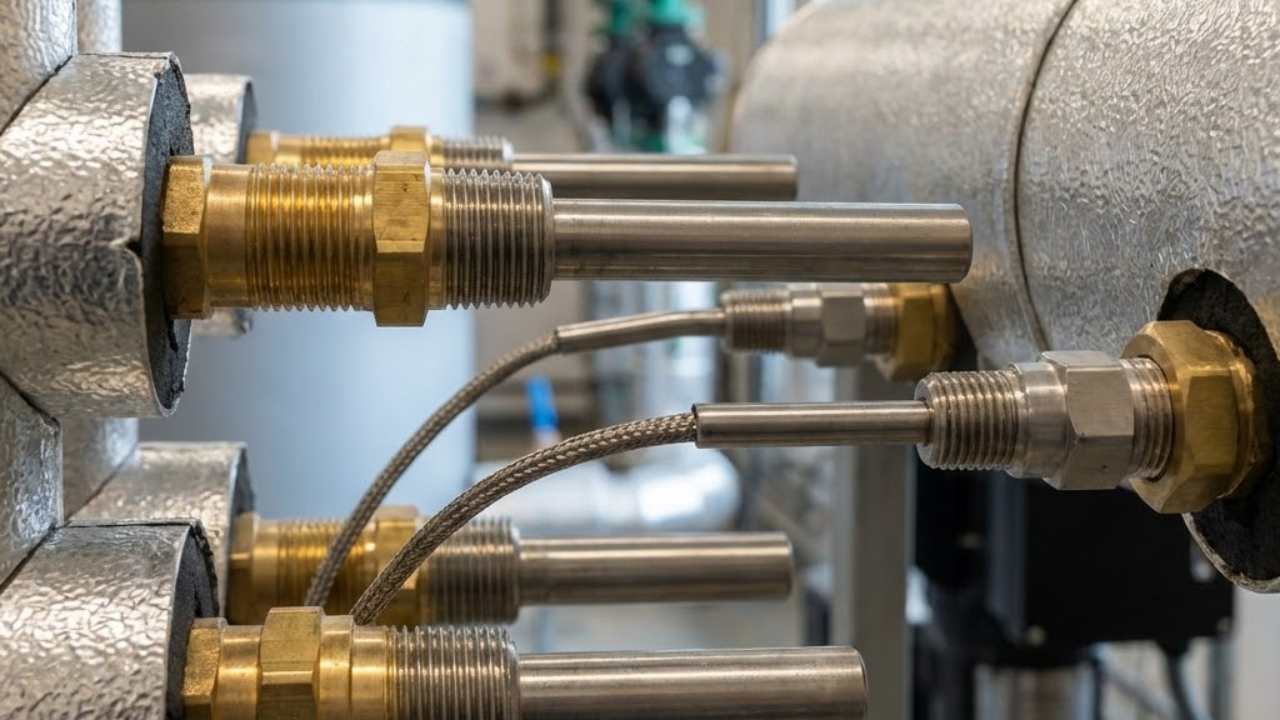
That's where thermometer pockets come in. These simple brass or stainless steel fittings create a sealed chamber in the pipework, allowing you to insert a temperature probe without shutting down the system or compromising the pressure envelope. For heating engineers working on anything from small commercial boilers to district heating mains, they're an essential component that often gets overlooked during the specification stage, until you need one and it's not there.
Understanding how they work, where to fit them, and how to select the right type ensures you can commission systems properly and provide ongoing diagnostics without invasive alterations.
What Thermometer Pockets Actually Do
A thermometer pocket (sometimes called a thermowell or immersion pocket) is a closed-end tube that screws into a pipe fitting or vessel. You insert a temperature probe, typically a PT100 sensor, PT1000 probe, or thermocouple, into the pocket, which extends into the fluid stream. The pocket conducts heat from the water to the sensor, giving you an accurate reading without the probe ever touching the system water.
This separation is critical. It means you can remove and replace sensors without draining down or breaking the pressure seal. It also protects expensive instrumentation from aggressive system water, especially in older installations where inhibitor levels might be questionable or where you're dealing with high-velocity flow that could damage an exposed sensor.
Think of it like a protective sleeve. The thermowell takes the beating from the system environment whilst your £200 PT100 sensor stays safe and functional.
In practice, thermometer pockets are fitted at strategic points. Flow and return headers, buffer vessel connections, heat exchanger inlets and outlets, and on primary circuits where you need to monitor differential temperatures for control or diagnostic purposes. Without them, you're either guessing at system temperatures or you're drilling and tapping live pipework. Neither of which is acceptable on a professional installation.
Why Accurate Temperature Monitoring Matters
Temperature is one of the most telling diagnostic parameters in any heating system. A 5°C difference between what you expect and what you measure can indicate a failing pump, a fouled heat exchanger, or a control valve stuck open. On a commercial boiler plant, monitoring flow and return temperatures across each boiler lets you spot inefficient firing, poor mixing, or return temperatures that are too low, risking condensation in non-condensing plant.
Consider a scenario on a light commercial job. You've commissioned a new cascade boiler system with a low-loss header and weather compensation. The building's warm, the boilers are firing, but the client's complaining about high gas bills. You check the flow and return temps at the header using thermometer pockets. Flow's sitting at 75°C when the compensator should be calling for 55°C. That tells you immediately that the mixing valve's bypassing or the compensator's misconfigured. Without accurate temperature monitoring at those points, you'd be chasing symptoms instead of diagnosing the root cause.
Thermometer pockets make this kind of real-time diagnostics possible. Fit them during installation, and you've got permanent test points that save hours of guesswork on callbacks. Miss them, and you're either relying on infrared guns (which can't read through insulation and give surface temps, not fluid temps) or you're trying to retrofit sensors into a pressurised system. Expensive and disruptive.
For comprehensive temperature monitoring solutions across all system types, Heating and Plumbing World stocks the instrumentation and fittings that professional installations demand.
Materials and Construction
Most thermometer pockets you'll encounter are either brass thermowell or stainless steel thermowell construction, with the choice depending on system pressure, temperature, and the aggressiveness of the fluid.
Brass thermowell fittings are the standard for domestic and light commercial heating systems. They're cost-effective, easy to machine, and suitable for system temperatures up to around 110°C and pressures to 10 bar. For typical sealed heating systems with inhibited water, brass is more than adequate. You'll often see them supplied with a 1/2" BSP thread for screwing into a boss or tee, with a 6mm, 8mm, or 10mm diameter pocket to suit common sensor sizes like PT100 sensor or PT1000 probe installations.
For systems requiring expansion vessels and pressurisation equipment, Altecnic Ltd supplies compatible brass thermowell options alongside their vessel ranges, ensuring complete system integration.
Stainless steel thermowell fittings are specified where you need higher temperature or pressure ratings, or where the system water is more aggressive. Think district heating mains, thermal stores operating at higher temperatures, or systems using untreated water where corrosion resistance is critical. Stainless (typically 316 grade) can handle temperatures well over 150°C and pressures exceeding 16 bar. They cost more, but they're the right choice for demanding applications where a failed thermowell means system downtime and expensive repairs.
The pocket itself is a closed-end tube, usually between 50mm and 150mm in insertion length. The deeper the pocket extends into the flow, the more accurate the reading, as you're measuring closer to the core temperature of the fluid rather than the boundary layer near the pipe wall. For most heating applications, a 100mm pocket is a good compromise between accuracy and mechanical stress on the fitting. Longer insertion length options reach deeper into large mains, but they're subject to more vibration and require thicker walls for structural integrity.
Where to Fit Thermometer Pockets
Strategic placement is everything. Fit them where temperature data gives you actionable information for commissioning, control, or diagnostics.
Every commercial boiler installation should have thermometer pockets on the flow and return headers, close to each boiler. This lets you measure the temperature rise across each appliance, confirm firing rates, and diagnose issues like short-cycling or poor return temperatures. On cascade systems, you can compare temps across multiple boilers to ensure they're all contributing evenly to the load.
Insert PT100 sensor or PT1000 probe units into these pockets during commissioning, and you've got real-time feedback on each boiler's contribution. If one boiler's showing a 15°C rise whilst the others are at 20°C, you know that boiler's not firing correctly. Could be a gas valve issue, a fouled heat exchanger, or an airflow problem. Without the thermometer pockets, you're guessing based on burner noise and flue gas temperatures.
For pump installations, Grundfos circulators benefit from accurate temperature monitoring on both flow and return sides, helping you verify system performance against design parameters.
If you're using a plate heat exchanger for DHW or as an interface between primary and secondary circuits, fit thermometer pockets on all four connections. Primary flow and return, secondary flow and return. This gives you the differential temperatures you need to calculate heat transfer and diagnose fouling or flow issues. A drop in differential on the secondary side, for instance, points to scaling inside the plates.
The PT100 sensor in each thermowell provides the data for efficiency calculations. If your heat exchanger should be delivering a 10°C rise on the secondary side but you're only seeing 7°C, something's wrong. Could be insufficient primary flow, fouled plates reducing heat transfer, or secondary flow rate too high. The temperature readings from properly positioned thermometer pockets tell you which.
Thermometer pockets at the top and bottom of a buffer vessel let you monitor stratification and confirm that the vessel's charging and discharging properly. If the bottom temperature's climbing too high, you know you've got poor stratification or oversized flow rates breaking up the thermal layers. On thermal stores, especially those feeding multiple zones, pockets at each draw-off let you verify outlet temperatures for safety and performance.
A brass thermowell with PT1000 probe at the top of a buffer vessel should read significantly hotter than the bottom during charging. If they're within a few degrees of each other, your stratification's broken down. That's wasted storage capacity and reduced system efficiency. Problems you can diagnose instantly with the right instrumentation.
In systems with a low-loss header (or hydraulic separator), fit thermometer pockets on the primary flow and return, and on each secondary circuit. This setup gives you a complete picture of how the primary plant is interacting with the building loads. You can spot issues like secondary pumps over-running the primary, or dead legs where flow's bypassing certain zones.
The temperature data from PT100 sensors in these thermometer pockets reveals hydraulic problems that pressure monitoring alone can't show. If your primary return is coming back at 60°C but your secondary returns are all at 45°C, something's mixing that shouldn't be. Track it down with differential temperature readings between circuits.
On larger installations (district heating mains, plantroom distribution pipework, or any system with multiple sub-stations), thermometer pockets become even more critical. You need them at every point where you're measuring energy transfer, billing, or monitoring system performance. British Standard BS 1041 provides guidance on temperature measurement in industrial processes, and whilst it's not heating-specific, the principles around sensor placement and thermowell design apply.
For these demanding applications, stainless steel thermowell construction is standard. The higher pressures, temperatures, and flow velocities exceed what brass thermowell fittings can safely handle. The insertion length on large mains might be 150mm or more to reach the core flow temperature, and the thermowell must be engineered to withstand the mechanical loads without fatigue failure.
Sizing and Selecting the Right Pocket
Choosing the right thermometer pocket means matching it to your sensor, your pipework, and your system parameters.
The internal diameter of the pocket must suit the sensor you're using. Common sizes are 6mm, 8mm, and 10mm. A PT100 sensor or PT1000 probe with a 6mm sheath fits a 6mm pocket with a small clearance for thermal paste, which improves heat transfer and response time. Too loose a fit, and you'll get slower, less accurate readings. Too tight, and you risk damaging the sensor during insertion.
Always apply thermal conducting paste to the sensor sheath before insertion into the thermowell. This isn't optional on professional installations. The paste fills air gaps between the sensor and the pocket wall, dramatically improving thermal contact. On systems where you're measuring small differentials (2-3°C across a heat exchanger, for instance), that improved thermal contact can make the difference between useful data and misleading readings.
Longer insertion length extends further into the flow, giving more accurate readings by avoiding the cooler boundary layer near the pipe wall. For pipes up to 50mm diameter, a 100mm pocket is typical. For larger mains (100mm and above), you might go to 150mm or even 200mm to get the sensor into the core flow. Just remember that longer pockets experience more mechanical stress from flow-induced vibration, especially at high velocities.
In high-velocity systems (over 2 m/s), you need to consider the wake frequency and potential for vibration fatigue. Stainless steel thermowell fittings with thicker walls and shorter insertion length are more robust in these conditions. If you're working on a system with high flow rates (say, a secondary DHW circuit with a plate heat exchanger), check the pocket's pressure and velocity ratings.
Most thermometer pockets have a 1/2" BSP parallel thread, designed to screw into a boss or tee fitting. Some manufacturers offer pockets with compression fittings or flanged connections for larger pipework. Make sure the thread type matches your fittings. Mixing parallel and taper threads is a recipe for leaks. And always use PTFE tape or a suitable thread sealant rated for the system temperature.
Flanged thermowell installations on large mains require proper gasket selection and bolt torque. Follow the manufacturer's installation instructions. Over-tightening can crack the flange or distort the thermowell, under-tightening causes leaks.
Installation Best Practices
Fitting a thermometer pocket isn't complicated, but there are a few things to get right.
Ideally, fit the thermowell perpendicular to the flow, so the sensor sits across the flow path rather than pointing upstream or downstream. This reduces the effect of flow velocity on the reading and minimises mechanical stress. If you have to fit it at an angle, avoid pointing it directly into the flow. High-velocity water hammering the end of the pocket can cause fatigue failures over time.
Mounting the thermowell horizontally or slightly downward also prevents air pockets from forming inside the pocket, which would insulate the sensor from the fluid temperature. An upward-facing thermometer pocket is asking for trouble. Air migrates upward and collects at the closed end, giving you readings that lag reality by minutes.
When you insert the PT100 sensor or PT1000 probe into the thermometer pocket, apply a small amount of thermal conducting paste to the sensor sheath. This fills any air gaps and improves heat transfer, giving you faster, more accurate readings. It's a small detail that makes a noticeable difference, especially on systems where you're trying to measure small differentials.
Skip the thermal paste, and your sensor might read 1-2°C low due to the air gap thermal resistance. On a heat exchanger where you're calculating efficiency from a 10°C differential, that 2°C error represents a 20% miscalculation. Professional installations use thermal paste. Rushed jobs skip it and wonder why the numbers don't add up.
For systems requiring sophisticated temperature control, brands like Danfoss offer control solutions that integrate seamlessly with thermometer pocket installations, helping you maintain optimal performance.
The thermometer pocket and sensor add weight and create a lever arm on the fitting. On larger installations, especially where you're using long pockets or heavy instrumentation, make sure the pipework's adequately supported. You don't want the weight of the sensor pulling on the thread and risking a leak.
Large stainless steel thermowell fittings on main headers can weigh several kilograms once you include the sensor and connection head. That's enough to stress a brazed joint if the pipe isn't properly bracketed. Plan support positions during installation, not after you discover a weeping joint six months later.
If the pipework's insulated, make sure you insulate around the thermowell too, leaving just the sensor connection exposed. This prevents the pocket from acting as a cold bridge, which would give you a falsely low reading. On high-temperature systems, this is critical. An uninsulated thermometer pocket can read 10°C or more below the true fluid temperature.
Picture a 90°C flow pipe with an uninsulated brass thermowell extending into a 20°C plant room. The exposed brass conducts heat away from the pocket, cooling the section where your sensor sits. Your PT100 sensor reads 82°C when the water's actually at 90°C. That 8°C error invalidates your differential temperature calculations and sends you chasing phantom faults.
Common Mistakes and How to Avoid Them
Even experienced engineers sometimes get thermometer pockets wrong. Here are the usual pitfalls.
Temperature profiles are uneven near bends, tees, or valves. Fit a thermowell too close to a 90° elbow, and you might be measuring a local hot or cold spot rather than the bulk fluid temperature. Aim for at least 10 pipe diameters downstream of any fitting, and 5 diameters upstream, if space allows. On tight plantrooms, that's not always possible, but the further you can get from disturbances, the better your data.
A thermometer pocket positioned 200mm downstream of a mixing valve might see stratified flow where hot and cold streams haven't fully mixed. Your sensor reads the temperature of whichever stream it's sitting in, not the mixed bulk temperature. Move it 500mm further downstream, and the reading suddenly makes sense.
A thermometer pocket that barely extends into the pipe gives you a reading closer to the pipe wall temperature than the fluid temperature. This is especially misleading on large-bore pipework where there's a significant temperature gradient across the diameter. If you're retrofitting pockets, check the insertion length and choose a length that gets the sensor well into the flow.
On a 150mm main carrying 80°C water at high velocity, the temperature near the pipe wall might be 2-3°C cooler than the core flow due to boundary layer effects. A short thermowell with 50mm insertion length reads 77°C when the bulk temperature is 80°C. That error compounds when you're calculating energy transfer or diagnosing heat exchanger performance.
Brass thermowell fittings are fine for most heating systems, but if you're working on a high-temperature thermal store or a system with aggressive water chemistry, stainless steel thermowell construction is worth the extra cost. Brass dezincifies in systems with poor inhibitor levels or high chloride content, leading to leaks and sensor failures. If in doubt, specify stainless.
An engineer once fitted brass thermometer pockets throughout a district heating system with untreated mains water. Within 18 months, several pockets had dezincified and started weeping. The replacements were all stainless steel thermowell units, which are still going strong years later. Material selection matters.
High-velocity systems, especially secondary DHW circuits or large commercial mains, can set up vibration in long, thin thermometer pockets. Over time, this causes fatigue cracks at the base of the thread. If you're working on a system with flow rates over 2 m/s, use a shorter, thicker-walled pocket, or consider a flanged thermowell designed for high-velocity applications.
Vibration-induced fatigue isn't immediately obvious. The thermowell looks fine for months, then one day you notice a small weep at the thread. By then, the crack's propagated deep enough that the fitting needs replacing. Prevention's better than cure. Specify proper mechanical ratings from the start.
Integration with Controls and BMS
Thermometer pockets aren't just for commissioning. They're permanent test points that integrate with your control strategy. On any system with a Building Management System (BMS), the sensors in those pockets feed data to the controller, enabling weather compensation, boiler sequencing, and energy monitoring.
For instance, on a cascade boiler system, the BMS reads flow and return temperatures from PT100 sensors in header thermometer pockets and calculates the system load. It then fires boilers in sequence to match demand, shutting down plant when it's not needed and maximising condensing operation. Without accurate temperature data from properly sited pockets, the control logic can't work effectively.
On larger commercial installations, thermometer pockets also support energy metering. Combined with flow meters, they let you calculate heat energy (in kWh) for billing or performance monitoring. This is a requirement under Building Regulations Part L for larger non-domestic buildings, where you need to demonstrate energy use and system efficiency. Fit the thermometer pockets during installation, and you've got the infrastructure in place for compliance and ongoing optimisation.
For systems requiring sophisticated control, brands like Honeywell offer a range of control solutions that integrate seamlessly with temperature monitoring from thermometer pockets, helping you maintain optimal system performance.
Maintenance and Sensor Replacement
One of the biggest advantages of thermometer pockets is that they let you replace sensors without disturbing the system. If a PT100 sensor or PT1000 probe fails or you need to upgrade to a more accurate sensor, you simply withdraw the old one and insert the new one. No draining, no cutting pipes, no downtime.
That said, it's worth checking the thermometer pockets themselves during annual servicing. Look for signs of corrosion, especially at the thread where dissimilar metals might be in contact. On older installations, you might find that the thermal paste inside the thermowell has dried out or that the sensor's loose. Both of which affect accuracy. A quick pull-and-check takes minutes and can save you from chasing phantom faults later.
If you're working on systems with glycol or untreated water, inspect brass thermowell fittings for dezincification. The brass turns pink or rough-textured as zinc leaches out, weakening the material. Catch it early, and you can replace the thermowell during planned maintenance. Miss it, and you're dealing with an emergency leak.
Specifying Thermometer Pockets on Your Next Job
If you're designing or quoting a commercial heating system, make thermometer pockets part of your standard specification. Include them in your bill of materials for any installation where temperature monitoring is critical. Boiler headers, heat exchangers, buffer vessels, and primary circuits. It's a small upfront cost that pays off in easier commissioning, better diagnostics, and long-term system optimisation.
When you're sourcing components, look for thermometer pockets with clear pressure and temperature ratings, and check that the thread type and pocket diameter match your sensors and fittings. For domestic and light commercial jobs, brass thermowell fittings with 1/2" BSP threads and 100mm insertion length cover most scenarios. For larger or more demanding systems, step up to stainless steel thermowell construction and check the mechanical ratings for high-velocity or high-pressure applications.
Conclusion
Thermometer pockets are one of those components that separate a professional installation from a basic one. They give you the accurate, repeatable temperature data you need to commission systems properly, diagnose faults quickly, and prove compliance with Building Regulations and manufacturer requirements. Fit them at the design stage, in the right locations with the right materials, and you've built in diagnostic capability that'll serve you and your client for the life of the system.
Whether you're working on a small commercial boiler replacement or a large district heating scheme, don't overlook these simple fittings. They're the difference between guessing at system performance and knowing exactly what's happening at every critical point in the circuit. And when you get that callback about high running costs or uneven heating, you'll be glad you've got reliable temperature data to start your diagnosis.
The PT100 sensor and PT1000 probe instruments you install in those thermometer pockets provide the visibility that transforms reactive maintenance into proactive system management. Whether you're using brass thermowell fittings for standard applications or stainless steel thermowell construction for demanding environments, proper insertion length and strategic placement deliver the accurate readings that professional heating engineering demands.
For a full range of thermometer pockets, sensors, and instrumentation to support your heating projects, explore the range at Heating and Plumbing World. If you need advice on specifying the right components for your next installation, contact us and speak to our technical team.