

Traditional Pipe Runs in Period Properties
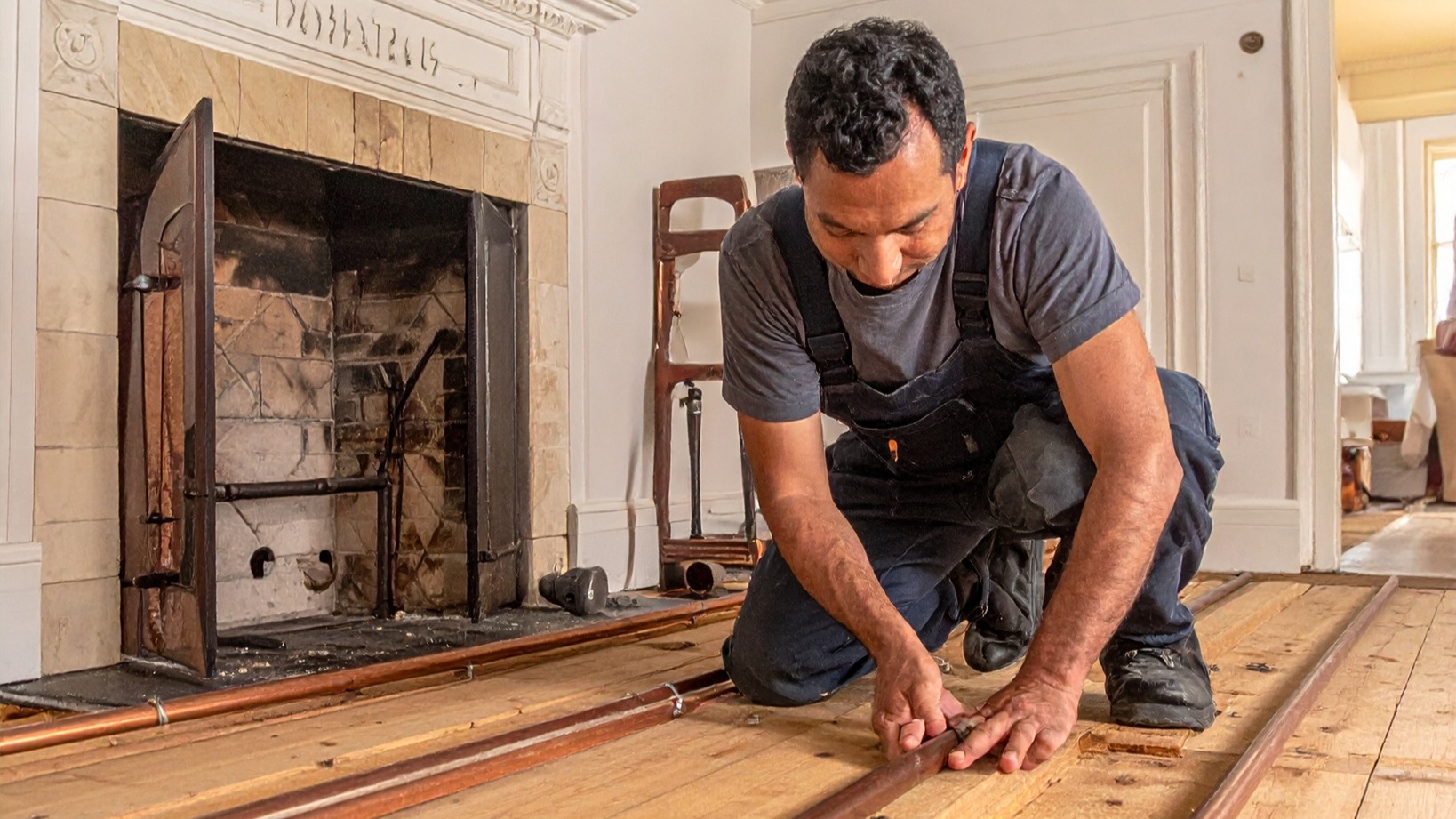
Period properties present unique challenges when it comes to heating systems. The thick walls, ornate plasterwork, and historic features that make these buildings beautiful also make modern plumbing installations considerably more complex. Projects that succeed do so because they respect the building's original design principles rather than fighting against them.
Why Modern Pipework Fails in Old Buildings
Victorian and Edwardian houses were built with specific expectations about how services would run. Builders anticipated coal fires, not central heating. They left no provision for 15mm copper pipes snaking through walls or radiator feeds cutting across original joinery.
When installers force contemporary pipe runs into these spaces, three problems emerge consistently:
Thermal movement damage: Modern copper pipe expands 0.18mm per metre for every 10°C temperature change. In a 6-metre run between floors, that's over 1mm of movement. Period properties with lime mortar and lath-and-plaster walls can't absorb this movement the way modern plasterboard can. Cracks appear in decorative cornices within 18 months of installation when pipes are run directly behind them.
Acoustic transmission: Solid walls in period properties transmit sound differently from cavity walls. A 22mm flow pipe running through a Georgian terrace's party wall creates noise complaints that wouldn't occur in a 1980s semi. The British Standard BS 8233:2014 sets residential noise limits, but these assume modern construction methods.
Structural compromise: Notching joists for pipe runs follows different rules when those joists are 200-year-old oak rather than regularised softwood. Building Regulations Approved Document A permits notches up to 0.125 of the joist depth, but this assumes consistent timber with known load characteristics. Original floor joists often carry loads they weren't designed for, and any reduction in section can trigger deflection issues.
How Traditional Pipe Routes Actually Worked
Before central heating, period properties had service routes built into their fabric. Understanding these original pathways makes modern installations significantly easier and supports effective traditional pipework restoration.
Chimney voids: Every fireplace creates a vertical service void. The space between the back of the chimney breast and the flue provided a natural route from the basement to the roof. In a typical three-storey Victorian terrace, this gives you four or five vertical risers already built into the structure. Primary flow and return pipes route through these voids in most successful period property installations.
Floor void access: Georgian and Victorian floors typically sit on joists running front-to-back, with boards running perpendicular. This creates clear routes for lateral pipe runs without cutting joists. The void depth varies; Georgian properties often have 250mm voids, whilst Victorian terraces might have 200mm, but both provide adequate space for an insulated 22mm copper pipe with room for future maintenance.
Service corridors: Many period properties have a rear addition or outrigger containing the original scullery or kitchen. These later additions (often built 20-30 years after the main house) create a natural service corridor. The wall between the main house and the outrigger usually has lower heritage value and provides the most practical route for vertical pipe runs.
Routing Primary Circuits Without Structural Damage
The flow and return pipes feeding your heating system carry water at 70-80°C. These primary circuits demand careful routing in period properties to maintain both efficiency and architectural integrity.
Basement to ground floor: If the property has a basement or cellar, this solves the ground floor problem. Run pipes along the basement ceiling joists, using traditional pipe clips spaced at 1.2m intervals for 22mm copper. Insulate with 19mm foam to British Standard BS 5422:2009 requirements. The basement ceiling is usually the ground floor's structural deck, so you're working below the decorative plaster.
Where no basement exists, the ground floor void becomes critical. Most period properties have suspended timber ground floors with 150-300mm voids. Access through existing floorboards rather than lifting entire sections. A 200mm wide board, carefully lifted and replaced, provides adequate access for pipe installation whilst preserving the original floor pattern.
Ground to first floor: This vertical run causes the most problems. The chimney breast route works for most installations, but requires careful execution. The void behind the chimney breast typically measures 100-150mm wide. This accommodates two 22mm pipes with insulation, plus a 10mm microbore if you're running a towel rail feed.
Access the void from the first floor by carefully removing one or two bricks from the back of the chimney breast at skirting level. This creates a permanent access point that's easily concealed with a small panel. Brass access plates on visible installations look intentional rather than apologetic.
First floor to second floor: In three-storey properties, continue using the chimney void if possible. Where chimney breasts reduce in size on upper floors, the party wall often provides an alternative route. Check the deeds first; you need party wall agreement for any work affecting the shared structure, even if you're only running pipes through an existing void.
Lateral Runs and Radiator Feeds
Once your primary circuit reaches each floor, you need lateral distribution to the radiators. Period properties offer several discreet routes for traditional pipe runs.
Skirting board runs: Original skirting boards in period properties typically stand 150-225mm tall and project 25-40mm from the wall. The void behind the skirting provides a natural route for 10mm or 15mm radiator feeds. Remove the skirting carefully (these are often single pieces of old-growth timber worth preserving), notch the plaster behind at floor level, and route the pipes before refitting.
This approach works for radiators positioned on external walls, the traditional location. You're running pipes exactly where heat loss occurs, minimising the dead leg between the primary circuit and the emitter.
Under floorboards parallel to joists: Where radiators sit on internal walls, running feeds under floorboards parallel to the joists avoids any joist notching. This requires lifting boards, but creates an invisible installation. Quality plastic piping systems from Polypipe work well for these runs; they're more forgiving of the slight deflection that occurs in old floors, and thermal movement is less problematic when the pipe isn't rigidly clipped.
Boxing and panelling: Some situations demand surface-mounted pipes. Rather than running modern plastic trunking across original plasterwork, construct period-appropriate boxing. A simple softwood box, 75mm x 75mm, painted to match the skirting, looks intentional. This approach works in listed buildings where conservation officers reject concealed routes that would damage the original fabric.
Managing Thermal Expansion in Rigid Structures
Copper pipe movement will damage period properties unless you account for it during installation. Three strategies prevent problems:
Expansion loops: In long straight runs (over 5 metres), incorporate an expansion loop. This is simply a deliberate S-bend in the pipe that absorbs linear expansion. The loop needs to project about 150mm from the wall for a 10-metre run. In chimney voids, this works perfectly; the loop sits in the void where it's invisible.
Flexible sections: At the connection between rigid copper runs and radiator tails, use 300mm of flexible connector. This absorbs both thermal expansion and any slight movement in the floor or wall. Stainless steel braided connectors rated to 110°C last longer and look appropriate in period properties. Quality pipe fittings and connectors make the difference between installations that last decades and those that need premature replacement.
Clip spacing: Reduce clip spacing to 800mm instead of the standard 1.2m on vertical runs. This prevents the pipe from bowing as it expands, which can crack plaster. Use traditional brass pipe clips; they look right, and they last. Plastic clips degrade over 20-30 years; brass clips outlast the pipework.
Working with Listed Building Constraints
Listed building consent adds another layer of complexity, but understanding the requirements helps projects succeed.
Reversibility: Conservation officers often require installations to be reversible; you must be able to remove the heating system and restore the building to its original state. This rules out chasing pipes into solid walls or cutting structural timbers. It makes chimney voids and floor voids even more critical, because these routes don't permanently alter the building fabric.
Matching materials: Some authorities require traditional materials in visible locations. Copper pipe with traditional brass fittings and compression joints instead of modern push-fit connectors takes longer to install, but the fittings are repairable and look appropriate in a period setting.
Documentation: Listed building applications require detailed drawings showing pipe routes and any structural interventions. A hand-drawn isometric showing how pipes route through existing voids, with photographs of the current condition, typically satisfies planning requirements. The application process adds 8-12 weeks to project timelines.
Balancing Systems in Asymmetric Layouts
Period properties rarely have the symmetrical layouts that make modern heating systems easy to balance. A Victorian terrace might have three rooms on the ground floor but four bedrooms on the first floor, all different sizes. The traditional approach to pipe sizing handles this better than modern manifold systems.
Pipe sizing by load: Calculate the heat requirement for each room, then size the radiator feed accordingly. A large front reception needing 4kW gets 15mm feeds; a small bathroom needing 1kW gets 10mm feeds. This creates a natural flow restriction that helps balance the system.
Reverse return circuits: In larger properties (four bedrooms or more), consider a reverse return circuit. The flow pipe runs to the furthest radiator first, and the return pipe comes back to the boiler from the nearest radiator. This equalises pipe lengths and makes balancing easier. The approach requires more pipe, but eliminates the common problem where rooms nearest the boiler overheat whilst distant rooms stay cold.
Traditional lockshield valves: Modern thermostatic radiator valves (TRVs) don't balance systems; they just restrict flow when rooms reach temperature. Use traditional lockshield valves on all radiators, set them during commissioning, and fit TRVs only where room-by-room control matters (bedrooms, bathrooms). This gives you proper hydraulic balance that TRVs alone can't achieve.
Effective system balancing also depends on proper circulation. Grundfos circulator pumps offer models specifically designed for the variable flow rates typical in period properties with asymmetric layouts, ensuring even heat distribution across all rooms.
System Pressurisation and Protection
Traditional pipework restoration requires attention to system pressure management. Period properties with varying floor heights and long pipe runs need properly sized expansion vessels to accommodate thermal expansion without triggering safety valve discharge.
Quality expansion vessels and system components from manufacturers like Altecnic ensure stable operating pressure regardless of the complex pipe routing typical in heritage buildings. These components compensate for the greater water volume in longer pipe runs without requiring frequent manual intervention.
Where systems include multiple zones across different floors, pressure balancing becomes critical. Each zone needs adequate static pressure to ensure radiators on upper floors heat properly whilst preventing excessive pressure on ground-floor components.
Boiler Selection for Traditional Systems
Modern condensing boilers from manufacturers like Andrews work effectively with traditional pipe runs when properly specified. The key is matching boiler output to system volume and selecting models with modulation ranges that suit the varied heat loads typical in period properties.
Combination boilers can struggle in period properties with long pipe runs and multiple bathrooms. System boilers paired with indirect cylinders from suppliers like Gledhill or Kingspan often provide better performance, storing hot water centrally rather than heating it on demand through extensive pipework.
Boiler positioning matters significantly in traditional installations. Locating the boiler centrally in the property minimises pipe run lengths and reduces heat loss in long circuits. Where this isn't possible, enhanced pipe insulation compensates for longer distribution distances.
Control Strategies for Traditional Systems
Heating controls need careful integration with traditional pipe runs. Simple time and temperature controls from manufacturers like Honeywell, Danfoss, or EPH Controls often work better than complex zoning systems in period properties where the pipe layout doesn't naturally divide into zones.
Weather compensation provides significant efficiency improvements in traditional systems. By adjusting flow temperature based on outdoor conditions, these controls reduce cycling and improve comfort whilst extending component life in older pipe networks.
Individual room control through TRVs works effectively when the underlying system is properly balanced. Without correct hydraulic balancing using lockshield valves, TRVs simply shift problems from room to room rather than solving them.
Common Mistakes That Damage Period Features
Five installation errors appear repeatedly in period properties:
Notching top edges of joists: Regulations permit notches in the top edge of joists, but only in the zone between 0.07 and 0.25 of the span from the support. Installers often notch wherever it's convenient, creating weak points that cause floors to deflect. In period properties with original plaster ceilings below, this deflection cracks the ceiling. Always notch in the permitted zone, or drill holes in the neutral axis (centre) of the joist instead.
Chasing into soft lime mortar: Period properties built before 1919 typically use lime mortar, not cement. Chasing pipes into lime mortar walls seems easy, the mortar cuts cleanly, but it compromises the wall's ability to flex with seasonal movement. The channelled section becomes a weak point where cracks develop. Surface-mounted pipes with appropriate boxing preserve the wall structure.
Inadequate insulation in voids: Pipes running through floor voids lose heat to the void, not the room above. In a typical Victorian floor void, an uninsulated 22mm flow pipe at 75°C loses 28 watts per metre. Over a 6-metre run, that's 168 watts, equivalent to leaving a light bulb running permanently. Insulate all pipes in floor voids to a minimum 19mm thickness.
Rigid connections to radiators: Fixing radiator brackets directly to lath-and-plaster walls, then making rigid pipe connections, transfers every movement into the wall. When the floor deflects slightly under load (normal in old buildings), the radiator moves, and the plaster cracks. Use flexible connections for the final 300mm to each radiator, and ensure radiator brackets fix to solid timber behind the plaster, not just the plaster itself.
Ignoring existing service routes: Many period properties already have pipes from previous heating installations or original gas lighting. These existing routes show you where the building tolerates services. Rather than creating new routes through different walls, use the established paths. Even if you're replacing everything, the original installer's route choices were usually correct.
Maintaining Traditional Installations
Systems installed using traditional pipe routes require minimal maintenance when executed properly. Annual checks should focus on:
- Inspecting accessible joints for signs of weeping or corrosion
- Checking pipe clips remain secure and haven't worked loose
- Verifying insulation remains intact in floor voids and other concealed spaces
- Testing system pressure and topping up if necessary
- Re-balancing radiators if the heat distribution becomes uneven
Access points installed during the original work become critical for ongoing maintenance. Small inspection hatches in discreet locations, inside cupboards, beneath stairs, or in service areas, allow essential checks without disturbing decorative finishes.
Achieving Long-Term Success
Traditional pipe runs in period properties succeed when they work with the building's original structure rather than against it. The chimney voids, floor voids, and service corridors built into Georgian, Victorian, and Edwardian houses provide ready-made routes for modern heating systems. These routes avoid damaging original features whilst creating installations that will last decades without maintenance.
The key principles, using existing voids, avoiding structural compromise, managing thermal expansion, and respecting heritage constraints, apply whether you're working on a Grade II listed townhouse or an unlisted Victorian terrace. The buildings share common construction methods that create common opportunities.
Period properties will outlast any heating system we install in them. The installations that succeed are those designed to be maintained, modified, and eventually replaced without damaging the building fabric that makes these properties worth preserving.
For specialist advice on heating components suitable for period property installations, Heating and Plumbing World supplies quality products that respect traditional building methods whilst delivering modern performance. If you need guidance on specific installation challenges, get in touch for expert recommendations.