

Underfloor Heating in Open-Plan Living Areas
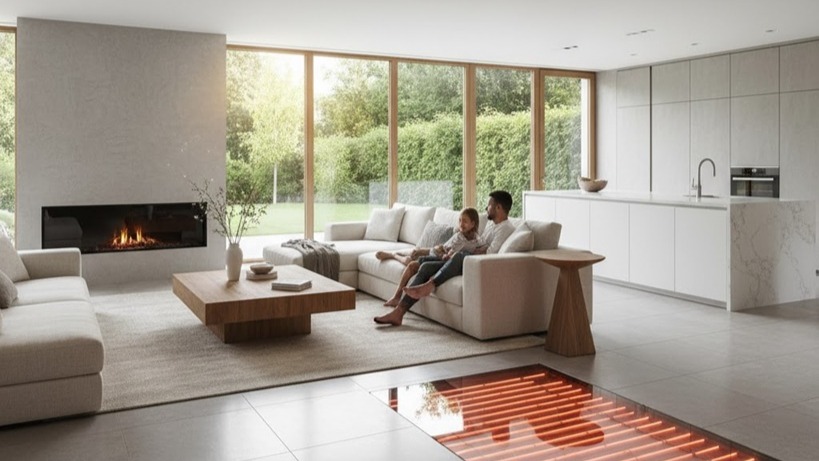
Open-plan living has transformed how we design heating systems. Gone are the days when you could treat each room as an isolated heat zone with a radiator on the wall and call it done when you're working with a single space that combines kitchen, dining, and living areas, often stretching 10 metres or more, the fundamentals of open-plan underfloor heating change completely.
The challenge isn't just about pumping more heat into a bigger floor. It's about understanding how heat moves across continuous surfaces, how different flooring materials in the same space affect output, and why a poorly designed underfloor heating design will leave some areas roasting whilst others stay cold. Heating and Plumbing World stocks the components you'll need, but the real work happens at the design stage.
This isn't theoretical. Get the zoning wrong in a 60 m² open-plan kitchen-diner, and you'll have a family eating breakfast in T-shirts whilst they need jumpers on the sofa three metres away. Miss the heat loss calculation for the glazed gable end, and the system won't compensate properly. These are the sorts of callbacks that waste everyone's time.
Why Open-Plan Spaces Need Different Thinking
Traditional room-by-room heating relies on boundaries. Doors close. Heat stays put. You can size a radiator or underfloor circuit for a defined space, knowing the heat won't immediately bleed into adjacent areas.
Open-plan changes that equation entirely. Heat migrates freely. The kitchen's cooking appliances add incidental heat gain. Large expanses of glazing, sliding doors, bifolds, and floor-to-ceiling windows create significant localised heat loss. You might have porcelain tiles in the kitchen transitioning to engineered wood in the living area, each with different thermal properties and output characteristics.
Think of it like this: heating a single room is like filling a bucket with water. Heating an open-plan space is like filling a shallow tray where the water constantly seeks its own level. You need multiple input points working together, not one circuit trying to do everything.
The floor construction itself often varies within the same space. The kitchen might sit on a concrete slab with screed. The living area extension could be timber joists with an insulated suspended floor. That's two entirely different pipe layouts, flow temperatures, and response times in what the client sees as "one room."
Ceiling heights add another variable. Vaulted or cathedral ceilings look stunning but increase room volume dramatically. A 50 m² floor area with a 2.4-metre ceiling needs roughly 120 m³ of heated air. Bump that ceiling to 4.5 metres in a double-height section, and you're heating nearly double the volume. The floor output stays the same, but heat stratification becomes a real concern.
Heat Loss Gets Complicated Fast
Standard heat loss calculations assume four walls, a ceiling, and a floor, all with defined U-values and surface areas. Open-plan spaces don't play by those rules. You're often dealing with one or two external walls, vast glazed sections, and internal areas with no external fabric at all.
Here's where it gets interesting. The centre of a large open-plan space, say, 8 metres from the nearest external wall, has virtually no heat loss except through the floor slab to the ground. That area needs far less output than the zone directly beneath a 4-metre run of bifold doors. If you design the system as a single zone with uniform pipe spacing throughout, you'll either overheat the core or underheat the perimeter. Neither's acceptable.
You need to map the space into thermal zones based on heat loss intensity. High-loss perimeter areas near glazing get tighter pipe spacing, maybe 100mm to 150mm centres. Mid-floor areas might run at 200mm centres. The core zone, furthest from external fabric, could stretch to 250mm or 300mm centres if the floor finish allows decent output.
Flow temperature becomes a balancing act. Lower temperatures (35°C to 40°C) deliver better efficiency and suit heat pumps brilliantly. But if you're fighting significant heat loss through a glazed wall, you might need 45°C to 50°C in that specific circuit. That's why manifold design and mixing valves matter; you can't run every circuit at the same temperature and expect consistent comfort.
Calculating heat loss accurately demands software or detailed manual calculations following BS EN 12831. Room-by-room spreadsheets don't capture the nuances of open-plan layouts. Professional heat loss software lets you model different zones within the same space, assign varying U-values to different sections, and account for thermal bridging around large glazed areas.
Air changes matter more in open-plan designs, too. A sealed modern build might only need 0.5 air changes per hour. An older property with draughty doors and single-glazed sections could hit 1.5 or 2 air changes. That's three to four times the ventilation heat loss, which dramatically affects the required floor output.
Zone Control: The Non-Negotiable
Single-zone control in an open-plan space is a recipe for complaints. The thermostat goes somewhere, usually on an internal wall away from direct sunlight and draughts. But that one sensor can't possibly account for how different areas of the space behave.
Picture this: you've got a thermostat mounted near the centre of the room. The morning sun streams through the south-facing glazing and heats the living area. The stat sees the temperature rise and shuts down the entire system. Meanwhile, the kitchen at the opposite end, north-facing, constantly loses heat through a poorly insulated external wall and stays cold. Your client's making breakfast in a cold spot whilst the sunny lounge overheats.
Multi-zone control solves this. You're typically looking at 2 to 4 zones minimum in a decent-sized open-plan space. Kitchen, dining, and living areas each get their own circuit, manifold channel, and room stat or smart TRV. Danfoss and EPH Controls both make zone controllers that work brilliantly with underfloor systems, giving you independent temperature control for each area.
The manifold needs enough channels to accommodate your zoning strategy. A 6-circuit manifold isn't overkill for a 60 m² to 80 m² open-plan space if you're running separate zones with different pipe densities and flow temps. Don't skimp on manifold capacity at the design stage; adding circuits later is expensive and disruptive.
Wiring actuators properly matters, too. Each zone needs its own actuator on the manifold, controlled by its respective thermostat. When the living area calls for heat, only that circuit's actuator opens. The pump runs, but the flow only goes where it's needed. Simple, effective, and it stops you wasting energy heating areas that are already warm.
Smart thermostats take this further. Programmable schedules mean the kitchen warms up before breakfast, whilst the living area stays cooler until evening. Geofencing can detect when occupants are out and drop temperatures automatically. Honeywell Evohome systems integrate seamlessly with underfloor heating, offering per-zone scheduling and remote control through smartphone apps.
Floor Construction and Screeding Considerations
The base you're working with dictates everything about the installation. Solid concrete slabs with screed are the easiest to work with for open-plan underfloor heating. You've got thermal mass, good heat distribution, and straightforward pipe laying. Insulation goes down first, 50mm to 100mm PIR board, depending on U-value requirements, then the pipe clips in place, then the screed flows over the top.
Screed depth affects response time and output. Too thin, less than 65mm over the pipes, and you risk cracking. Too thick, and the system takes forever to warm up or cool down. A well-mixed liquid screed at 75mm over 16mm pipe hits the sweet spot for most applications: good thermal conductivity, reasonable response time, and enough strength for floor finishes.
Anhydrite screeds cure faster than traditional sand-cement mixes, which matters when you're on a tight programme. They self-level beautifully, creating a flatter surface for tiles or engineered wood. The trade-off? They're more expensive and require controlled drying; you can't just whack the heating on full blast straightaway, or they'll crack.
Timber suspended floors need a different approach entirely. You can't pour liquid screed over joists. Instead, you're looking at low-profile systems, either aluminium plates that sit between joists with pipes clipped in, or modular panel systems that create channels for the pipework. Polypipe offers solid options for both screeded and dry systems, depending on what the floor build-up allows.
Here's the kicker: thermal performance changes dramatically between systems. A wet screed system can deliver 80 to 100 W/m² at typical flow temperatures. A dry timber system might only manage 50 to 60 W/m². That's a huge difference when you're trying to offset heat loss in a space with big windows. If the calculations show you need 85 W/m² to maintain comfort, a dry system won't cut it unless you increase flow temperatures or reduce pipe spacing, both of which have limits.
Floor finish compounds the issue. Porcelain or ceramic tiles are brilliant for heat transfer, with thermal resistance of around 0.01 m²K/W. Engineered wood sits at 0.05 to 0.10 m²K/W depending on thickness. Thick carpet with a heavy underlay? You're looking at 0.15 m²K/W or more, which strangles output by 30% to 40%. In open-plan spaces where flooring often changes between areas, you've got to account for those variations in your design. The tiled kitchen area will output more heat than the wooden living area, even if the pipework underneath is identical.
Manifold Positioning and Circuit Design
The manifold's your distribution hub. Every circuit runs from here. Positioning it centrally, or as centrally as the building layout allows, minimises pipe run lengths and reduces heat loss in the flow and return legs. Ideally, you want it within 10 to 15 metres of the furthest circuit to keep things balanced.
In open-plan designs, the manifold often ends up in a utility room, under the stairs, or in a dedicated cupboard near the centre of the space. You need accessibility for maintenance and adjustment, but it doesn't have to be visible. Just don't bury it somewhere you can't reach without pulling up floor finishes; that's asking for trouble.
Pipe layout patterns matter more than you'd think. Continuous spiral (coil) patterns distribute heat evenly and are perfect for perimeter zones near glazing. The flow and return pipes interleave, which balances temperature across the floor surface beautifully. For lower heat loss areas, a single-snake pattern (meander) works fine and uses less pipe per square metre.
Maximum circuit length depends on pipe diameter and flow rate. With a 16mm pipe, you're looking at roughly 100 to 120 metres per circuit before pressure drop becomes problematic. Oversized open-plan areas often need multiple circuits to stay within these limits. A 70 m² space might be split into three or four circuits of 60 to 80 metres each, depending on pipe spacing and layout.
Balancing the manifold is critical. Each circuit needs a flow rate that matches its design heat output. Too much flow, and you're wasting pump energy. Too little, and the circuit won't deliver its rated output. Grundfos Alpha pumps with auto-adapt mode simplify this; they adjust speed based on system demand, but you still need to set the flow meters on the manifold correctly during commissioning.
Pressure testing before screeding isn't optional. You want the system filled, pressurised to 6 bar, and left for 24 hours minimum. Any leaks show up now, not after you've poured 4 tonnes of screed over everything. Keep the system pressurised during screeding too, it stops pipes floating or moving as the liquid flows around them.
Common Mistakes That Cost Callbacks
A few years back, a contractor I knew got called back to a new-build open-plan kitchen-diner. Beautiful space, vaulted ceiling, bifolds across the entire back wall, polished concrete floor. The underfloor system was in, commissioned, and running. The problem? The far end of the room, closest to the glazing, never got warm enough. Mornings were the worst.
Turns out, they'd designed the system as a single zone with uniform 200mm pipe spacing throughout. No account for the massive heat loss through the bifolds. No tighter pipe spacing near the external wall. Just one thermostat plonked in the middle of the room, which hit setpoint based on the warmer core area and shut everything down. The perimeter stayed cold.
The fix wasn't cheap. They had to lift sections of the screed, add a second circuit with 100mm spacing near the glazing, install a second zone on the manifold, and re-commission the whole system. Two weeks of disruption, materials, labour, and an unhappy client who'd been freezing for three months. All can be avoided with proper heat loss calculations and zone planning at the design stage.
Other common mistakes? Undersizing the pump. Open-plan systems with multiple circuits and varying pipe lengths need decent pressure to overcome resistance. A pump that's fine for two short circuits in a small room won't cope with five circuits totalling 400 metres in a sprawling open-plan space. Calculate total head loss properly, including the resistance through the manifold, pipe runs, and any mixing valves or zone valves in the system.
Forgetting about furniture is another classic. Clients love putting a massive corner sofa directly over the underfloor heating in the living area. The floor beneath it barely releases any heat; it's all trapped under the furniture. That section of the circuit effectively becomes dead space, which throws your output calculations off if you haven't accounted for it. Always ask about furniture layouts during the design phase, and either adjust pipe spacing around fixed furniture or warn clients about placing heavy items over heated areas.
Skipping insulation under the slab is madness but it still happens. Without proper edge insulation and under-slab insulation, you're heating the ground beneath the house instead of the room above. Heat loss downwards can account for 20% to 30% of total output. That's money vanishing into the earth every time the system fires up.
Choosing the Right System Components
The heat source matters. Gas boilers can comfortably run underfloor systems at 50°C to 55°C flow temperature, giving you flexibility for high heat loss areas. Heat pumps prefer lower temperatures, 35°C to 45°C, which is perfect for well-insulated open-plan spaces, but struggles if the building fabric is poor.
Blending valves or weather compensation help enormously. They modulate flow temperature based on outdoor conditions, ramping up when it's freezing and dropping back during milder weather. That keeps the system efficient and prevents overheating when external temperatures rise. Honeywell and Danfoss both make reliable mixing valves that integrate with most systems.
Manifold quality separates a job that runs smoothly for 20 years from one that leaks or jams after five. Brass manifolds with nickel-plated finish, built-in flow meters, and proper drain-off points are worth the extra cost. You want individual isolation valves on each circuit so you can isolate one zone without draining the entire system. Gledhill and other manufacturers supply pre-assembled manifolds with actuators and control wiring, which saves time during installation.
Pipe choice is usually 16mm or 20mm PE-Xa or PE-RT. PE-Xa's got better flexibility and memory, which makes it easier to work with during installation. PE-RT's cheaper but slightly stiffer. For open-plan systems with long runs and tight bends, PE-Xa saves time and frustration.
Don't forget expansion vessels and pressure relief if you're running a sealed system. The larger the system volume, the bigger the vessel you'll need. A 5-litre vessel might suit a small single-zone system, but a multi-zone open-plan installation with 300 to 400 metres of pipe could need 12 to 18 litres to handle expansion properly. Altecnic Ltd supplies expansion vessels in a range of sizes for exactly this purpose.
Air removal is crucial, too. Automatic air vents on the manifold prevent airlocks that kill circulation and create cold spots. Every high point in the system needs venting; the manifold is the obvious location, but long horizontal runs can trap air bubbles that reduce flow and efficiency.
Commissioning and Handover
Proper commissioning separates a system that works from one that limps along. Start by purging each circuit individually, running water through until it flows clear with no air bubbles. Then pressurise the system, bleed the manifold, and run through a full heating cycle with all zones calling for heat.
Balance the flow rates using the meters on the manifold. Each circuit should match its design flow, typically 1 to 3 litres per minute, depending on circuit length and output requirements. If one circuit's flowing twice as much as another, you'll get uneven temperatures and wasted pump energy.
Temperature checks confirm everything's working. With the system at operating temperature, an infrared thermometer or thermal camera shows up cold spots, short circuits, or areas where insulation is missing. The floor surface temperature should be consistent across each zone, usually 23°C to 28°C, depending on the room setpoint and floor finish.
Leave clear documentation for the client. Circuit layouts, zone assignments, thermostat settings, and pump parameters all need recording. When someone inevitably calls you back in five years because they've "forgotten how it works," you want answers at your fingertips.
Getting the Design Right from the Start
Open-plan underfloor heating isn't plug-and-play. It demands proper heat loss calculations, thoughtful zoning, and component selection that match the building's thermal performance and layout. Cutting corners at the design stage leads to callbacks, inefficient systems, and unhappy clients.
The payoff for doing it properly? Consistent comfort across the entire space, lower running costs, and a system that adapts to how people actually use the room. That's what separates a decent installation from an outstanding one.
If you're speccing components for an open-plan project, contact us to discuss manifold options, pump sizing, and control systems that'll actually work with your design. The technical details matter here; getting them right makes all the difference.