

Vaillant 0020132764 PCB: F22, F28, F29 Electronic Fault Resolution
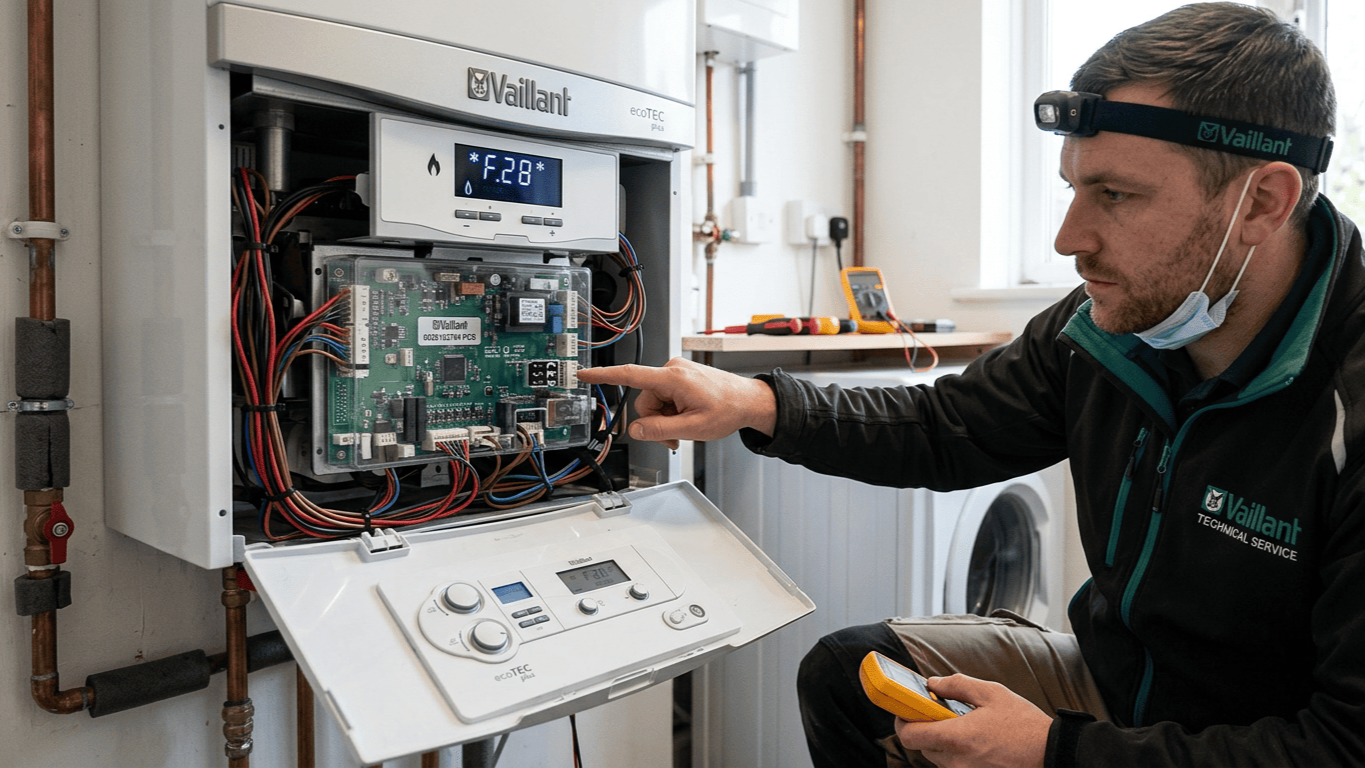
Your boiler is showing F22 on the display, and you're likely wondering whether you need a new board or a decent diagnostic. The Vaillant 0020132764 pcb sits at the very heart of the ecoTEC range. When it throws codes like F22, F28, or F29, it's often telling you something specific about the system's health.
Understanding what these codes actually mean saves you from unnecessary part swaps and wasted call-outs. Think of the Vaillant 0020132764 pcb as the central computer in a modern car. It monitors everything from pressure to temperature to keep the journey safe and smooth. Consequently, a warning light doesn't always mean the computer itself is broken.
This board is surprisingly robust when treated properly. However, it is also sensitive to voltage spikes, condensate ingress, and poor earthing. We've seen boards fail after lightning strikes, but many outlast the boiler itself when maintained correctly.
What The 0020132764 PCB Actually Controls
The Vaillant 0020132764 pcb is the main control board for ecoTEC Plus and Pro models manufactured between 2005 and 2012. It manages ignition sequencing, pump modulation, gas valve operation, and safety interlocks. Engineers often refer to this component as the "brains of the boiler" for good reason.
This board receives inputs from multiple sensors to maintain efficient operation. These include:
- The flow temperature sensor
- The return temperature sensor
- The pressure transducer
- The flame sensing electrode
The whole system operates on a closed-loop principle. This means the board constantly monitors and adjusts to maintain your set parameters. Furthermore, the board includes built-in diagnostics that log your fault history. Sourcing genuine Heating and Plumbing World components is vital for a reliable repair.
Understanding F22: Low Water Pressure Faults
The f22 fault code appears when system pressure drops below the minimum threshold. Typically, this threshold is around 0.5 bar. The pressure transducer feeds this data directly to the board, which shuts down the boiler to prevent heat exchanger damage.
Before you blame the board, check the front pressure gauge. If it reads below 1 bar, you have a genuine low-pressure condition. Common causes include slow leaks in radiator valves or an expansion vessel that has lost its pre-charge. If you find the vessel is faulty, fitting a Zilmet Hy-Pro expansion vessel will restore system stability.
If the gauge shows adequate pressure but the error persists, you must perform a pressure transducer test. The PCB only reports what the transducer tells it. A faulty sensor or a poor electrical connection can trigger false f22 fault code alerts. Testing the transducer output with a multimeter should show approximately 1 volt at 1 bar pressure. Consequently, a proper pressure transducer test prevents expensive misdiagnosis.
Decoding F28: Ignition Failure Diagnostics
The f28 fault code means the boiler attempted ignition but failed to detect a flame within the programmed time window. The board controls this sequence precisely. It opens the gas valve, fires the ignition electrode, and monitors for the current that confirms combustion.
This fault has multiple potential causes that you must check systematically:
- Verify the gas supply is on at the meter.
- Inspect the condition of the ignition electrodes.
- Check the flame sensing electrode position.
- Test for poor earth continuity.
The ionisation circuit is particularly sensitive. When combustion occurs, the flame conducts a tiny flame ionisation current back to the board. If this circuit is interrupted by a dirty electrode, you will get an error. In some gas-fired systems, checking the Oxy-Pilot NG9040 is also a wise move to ensure the pilot assembly is clean and producing a steady flame ionisation current.
F29 Faults: Flame Loss During Operation
The f29 fault code indicates the boiler ignited successfully but then lost the flame during the heating cycle. The board detected the flame ionisation current during startup but lost it unexpectedly later. This suggests an intermittent problem rather than a total component failure.
Common triggers for an f29 fault code include:
- Blocked condensate traps creating back pressure.
- Flue blockages causing combustion instability.
- Faulty gas valves that are not modulating smoothly.
- Intermittent gas supply issues from the meter governor.
Condensate blockages are very common with these errors. If the trap fills or freezes, combustion gases cannot vent properly. Consequently, the flame becomes unstable and the board locks out. Ensure your Worcester Bosch condensate pump or gravity drain is completely clear to avoid this headache.
Testing The PCB: What To Check Before Replacement
Before ordering a new Vaillant 0020132764 pcb, you must run through systematic checks. Start with the power supply quality. Measure the voltage at the boiler terminals to ensure it is a stable 230V. Voltage drops during pump startup often indicate supply problems that cause erratic behaviour.
Next, inspect all wiring connections to the board. Remove each connector and check for green oxidation or corrosion. We have fixed more "faulty" boards with contact cleaner than we have with actual replacements. Furthermore, verify the board is actually sending power to components like the Worcester Bosch condensate pump when required.
Finally, look for obvious physical damage. Check for burnt components or bulging capacitors. The board uses surface-mount parts that can fail from thermal cycling. However, visible damage is relatively rare unless there has been a significant voltage spike.
Common Misdiagnosis: When It Is Not The PCB
The most expensive mistake in boiler repair is replacing a good board because you didn't test the peripherals. We've seen engineers swap boards for problems caused by faulty sensors or poor system design. For example, if you find a leak in a Kingspan Albion Fortic tank, the resulting pressure drop is not an electronic fault.
On a recent service visit, a homeowner had already paid for a board replacement to fix a persistent f28 fault code. However, the fault returned within hours. When we inspected the unit, we found a simple hairline crack in the electrode's ceramic insulator. This was a £20 fix that would have saved them a £250 board bill.
If you are working on a large-scale system with a Tribune indirect cylinder, check all external controls first. The f28 fault code is often triggered by simple external issues. Always complete your pressure transducer test and electrode checks before condemning the main control unit.
Conclusion
The Vaillant 0020132764 pcb is a robust control system that responds predictably to inputs. It is not a mysterious "black box." Codes like F22, F28, and F29 point you toward pressure issues, ignition problems, or flame instability. They do not automatically indicate a board failure.
Most electronic faults in heating systems actually stem from sensors and connections. Test systematically and check the obvious causes first. This approach saves time and prevents the frustration of fitting a new part only to find the fault persists. Only replace the board when you have eliminated everything else.
Protect your new board from voltage spikes and moisture to ensure another decade of reliable service. If you are struggling with a complex fault, please consult our technical experts for professional advice. We are here to help you get the job done right the first time.