

When to Upgrade from a Back Boiler: Modern Alternatives
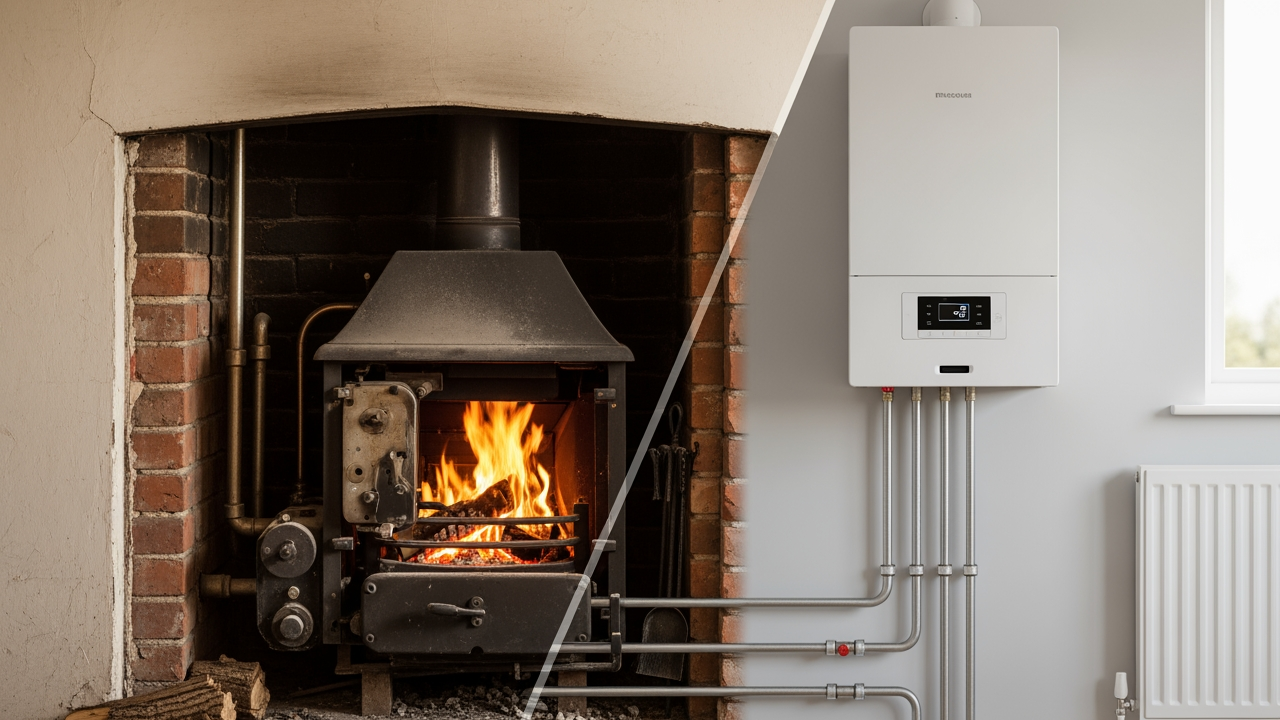
Back boilers haven't been manufactured since the early 2000s, yet thousands remain operational in UK homes. These heating relics sit behind gas fires or fireplaces, taking up valuable living space while burning through fuel at rates that would horrify modern homeowners. If your property still runs on one, you're likely spending 30-50% more on heating than necessary.
The question isn't whether to upgrade, it's when and to what. Hundreds of back boiler replacement projects across residential and commercial properties follow predictable patterns based on age, performance, and cost trajectory.
Why Back Boilers Became Obsolete
Back boilers stopped production for three reasons: efficiency, safety, and space. Modern condensing boilers achieve 90-95% efficiency ratings, whilst back boilers typically operate at 55-65%. That 30-40% gap translates directly to your energy bills.
The design itself creates problems. Back boilers heat water by sitting behind a gas fire, which means you're often running the fire just to heat water, even in summer. The heat exchanger corrodes faster than modern alternatives because combustion gases pass directly through it. Parts scarcity has become acute; manufacturers discontinued components years ago, forcing engineers to fabricate custom solutions or source reclaimed parts.
Safety concerns escalated as units aged. Carbon monoxide risks increase with corroded heat exchangers, and many back boilers predate modern safety controls. Gas Safe engineers regularly condemn units during annual services, particularly those over 20 years old.
Clear Signs Your Back Boiler Needs Replacement
The system takes longer to heat water. If your morning shower requires 15-20 minutes of waiting versus the 5-10 minutes it took years ago, the heat exchanger has likely degraded. Scale buildup and corrosion reduce heat transfer efficiency progressively.
Radiators heat unevenly. Cold spots at the top indicate circulation problems or sludge accumulation. Back boilers struggle to maintain consistent pressure in modern heating systems, especially in properties with multiple bathrooms or extensions added after the original installation.
Strange noises during operation. Kettling, a sound like a boiling kettle, signals scale buildup on the heat exchanger. Banging or clunking points to circulation pump failure or airlocks. These aren't minor inconveniences; they're warnings of impending failure.
Visible corrosion or leaks. Water stains around the fireplace, damp patches on surrounding walls, or rust on visible pipework indicate seal failure. Back boilers often leak slowly for months before catastrophic failure, causing hidden damage to the property structure.
Annual service costs exceed £300. When repair bills start climbing, you're maintaining a dying system. Homeowners have spent £800-1,200 annually keeping back boilers operational, money that could fund a replacement within three years.
The unit is over 15 years old. Even well-maintained back boilers approach end-of-life at this age. Replacement parts become impossible to source, and efficiency has degraded significantly from the original specifications.
Modern Replacement Options
Combi Boilers
Combination boilers provide instant hot water without storage tanks, making them ideal for properties with limited space. They heat water on demand, eliminating the standing losses that plague back boiler systems.
Best for: Flats, small to medium homes (up to 3 bedrooms, 1-2 bathrooms), properties where space is premium.
Efficiency gains: 90-94% efficiency translates to £300-500 annual savings on typical heating bills compared to back boilers.
Limitations: Hot water flow rate drops when multiple taps run simultaneously. If your household regularly uses two showers concurrently, consider alternatives.
Combi boilers feature in 60% of back boiler replacement projects because they eliminate both the back boiler and the hot water cylinder, freeing substantial space. The combi boiler installation process typically takes 1-2 days, including removal of old systems and pipework modifications.
System Boilers
System boilers work with a separate hot water cylinder but incorporate most components internally, with no feed tanks in the loft. They deliver high hot water flow rates to multiple outlets simultaneously.
Best for: Larger homes (4+ bedrooms, 2+ bathrooms), properties with high simultaneous hot water demand, homes with solar thermal systems.
Efficiency gains: 92-95% efficiency, with the added benefit of storing hot water heated during off-peak electricity periods if you have Economy 7 tariffs.
Space requirements: You'll need room for a cylinder (typically 150-300 litres), but you'll reclaim the loft space previously occupied by feed and expansion tanks.
System boilers suit properties where multiple family members need showers simultaneously or where water pressure is variable. The stored hot water provides consistent performance regardless of mains pressure fluctuations.
Heat Pumps
Air source heat pumps extract heat from outside air, even in cold weather. They're electric-powered but achieve 300-400% efficiency by moving heat rather than generating it through combustion.
Best for: Well-insulated properties, homes with underfloor heating or oversized radiators, environmentally-conscious homeowners, properties off the gas grid.
Efficiency gains: Running costs typically match or slightly exceed modern gas boilers at current energy prices, but with zero direct carbon emissions. Government grants (Boiler Upgrade Scheme) provide £7,500 towards installation costs as of 2024.
Considerations: Heat pumps work best with lower flow temperatures (45-55°C versus 65-75°C for gas boilers), requiring larger radiators or underfloor heating. Installation costs run £8,000-14,000 before grants.
Heat pump installations have increased 40% year-on-year as homeowners plan for future gas boiler phase-outs. Properties upgrading from back boilers often need radiator replacements to accommodate lower flow temperatures effectively.
Cost Comparison
A back boiler system costs approximately £1,200-1,800 annually to run in a typical 3-bedroom semi-detached home (based on 2024 energy prices). Here's how replacements compare:
Combi Boiler:
- Installation: £2,500-3,500
- Annual running costs: £700-900
- Annual savings: £400-700
- Payback period: 4-6 years
- Lifespan: 12-15 years
System Boiler:
- Installation: £3,000-4,200 (including cylinder)
- Annual running costs: £750-950
- Annual savings: £350-650
- Payback period: 5-7 years
- Lifespan: 12-15 years
Heat Pump:
- Installation: £8,000-14,000 (£500-6,500 after BUS grant)
- Annual running costs: £800-1,100
- Annual savings: £100-400 (plus future-proofing against gas phase-out)
- Payback period: 8-15 years without a grant, 2-8 years with a grant
- Lifespan: 20-25 years
These figures assume professional installation and don't include potential savings from improved property value. Estate agents report that modern heating systems add 2-5% to property valuations, particularly in areas where back boilers remain common.
What Back Boiler Replacement Actually Involves
Survey and design (Day 1): A Gas Safe engineer assesses your property, calculating heat loss for each room and determining optimal boiler sizing. Under-sized boilers struggle to heat your home; oversized units cycle inefficiently. Measuring radiator outputs, insulation levels, and hot water demand patterns ensures correct specification.
Removal (Day 1-2): The back boiler, fireplace (if integrated), hot water cylinder, and feed tanks come out. This creates significant debris, expect 2-3 builder's bags of material. Protect floors and furniture, but clear the area beforehand.
Installation (Day 2-3): New boiler mounting, pipework modifications, and system flushing. Modern boilers require cleaner systems than back boilers tolerated, requiring thorough flushing and an inhibitor to prevent future corrosion. If you're upgrading to a heat pump, expect 3-5 days for installation, including electrical work.
Commissioning and handover (Final day): The engineer tests all functions, balances radiators, and demonstrates controls. You'll receive building regulations compliance certification and manufacturer warranty documentation.
Most back boiler replacement projects take 2-3 days for gas boilers, 4-5 days for heat pumps. You'll be without heating and hot water during this period. Installations are typically scheduled during warmer months to minimise disruption.
Maximising Your Upgrade Investment
Address radiators simultaneously. If your radiators are over 15 years old or show corrosion, replace them during boiler installation. Labour costs drop significantly when engineers are already on-site, and new radiators ensure your system performs optimally.
Upgrade controls. Smart thermostats and thermostatic radiator valves (TRVs) add £200-400 to installation costs but save 15-25% on heating bills. They're particularly effective with new boilers because precise control maximises efficiency gains.
Consider power flushing. If keeping existing radiators, power flushing removes sludge and scale that accumulated during the back boiler's operation. This costs £300-500 but extends radiator life and improves heat distribution.
Insulate before upgrading to heat pumps. Heat pumps work efficiently in well-insulated properties. If considering a heat pump, assess loft insulation (aim for 270mm), cavity wall insulation, and draught-proofing first. These improvements reduce the heat pump size needed and lower running costs.
Reclaim the space. Removing a back boiler and cylinder frees 2-4 square metres of floor space. Plan how you'll use this before installation, whether extending the room, adding storage, or reconfiguring the layout. Some homeowners install wood-burning stoves in the reclaimed fireplace space, though this requires separate flue installation and compliance with smoke control regulations.
Timing Your Replacement Strategically
Don't wait for complete failure. Emergency replacements cost 20-30% more than planned installations because you're forced to accept limited options and rushed schedules. You'll also face days without heating while sourcing parts and scheduling engineers.
Plan for spring or summer installation. Heating engineers are less busy, often offering better prices and faster scheduling. You'll manage without heating more easily during warm weather.
Check for available grants. The Boiler Upgrade Scheme provides £7,500 for heat pumps, but funding isn't unlimited. Local authority schemes occasionally offer additional support for low-income households or specific property types.
Consider energy price forecasts. Gas and electricity price ratios affect heat pump economics. When electricity costs less than 3.5 times gas prices, heat pumps become cost-competitive with gas boilers for running costs.
Factor in property plans. If you're planning to sell within 2-3 years, a mid-range combi boiler offers the best return. If you're staying long-term, heat pumps provide better lifetime value despite higher upfront costs.
Back boilers represent obsolete technology that costs you hundreds of pounds annually in wasted energy. The typical 15-20-year-old back boiler operates at 55-65% efficiency, whilst modern alternatives achieve 90-95%, cutting heating bills by 30-50%.
Replacement timing depends on your specific situation. If your back boiler shows signs of failure, inconsistent heating, strange noises, visible corrosion, or you're facing repair costs above £300 annually, replace it now. Even if it's still functioning, units over 15 years old warrant replacement based purely on efficiency savings and avoiding emergency failure.
For most properties, combi boilers offer the best combination of cost, space savings, and performance. Larger homes with multiple bathrooms benefit from system boilers, whilst heat pumps suit well-insulated properties and are future-proof against gas heating phase-outs.
The investment pays back within 4-8 years through reduced energy bills alone, before considering improved comfort, reliability, and property value. More importantly, you'll eliminate the constant concern about when your ageing back boiler will finally fail, usually at the worst possible moment.
Plan your replacement proactively, during warmer months when engineers offer better availability and pricing. You'll appreciate the foresight when you're enjoying consistent heating, lower bills, and reclaimed living space where that inefficient relic once sat.
Heating and Plumbing World supplies modern heating solutions from leading manufacturers, including Andrews water heaters, Honeywell heating controls, Grundfos circulation pumps, and EPH Controls smart thermostats. For professional advice on your back boiler replacement project, get in touch with the technical team.