

Whole House Pump Systems vs Single Shower Pumps
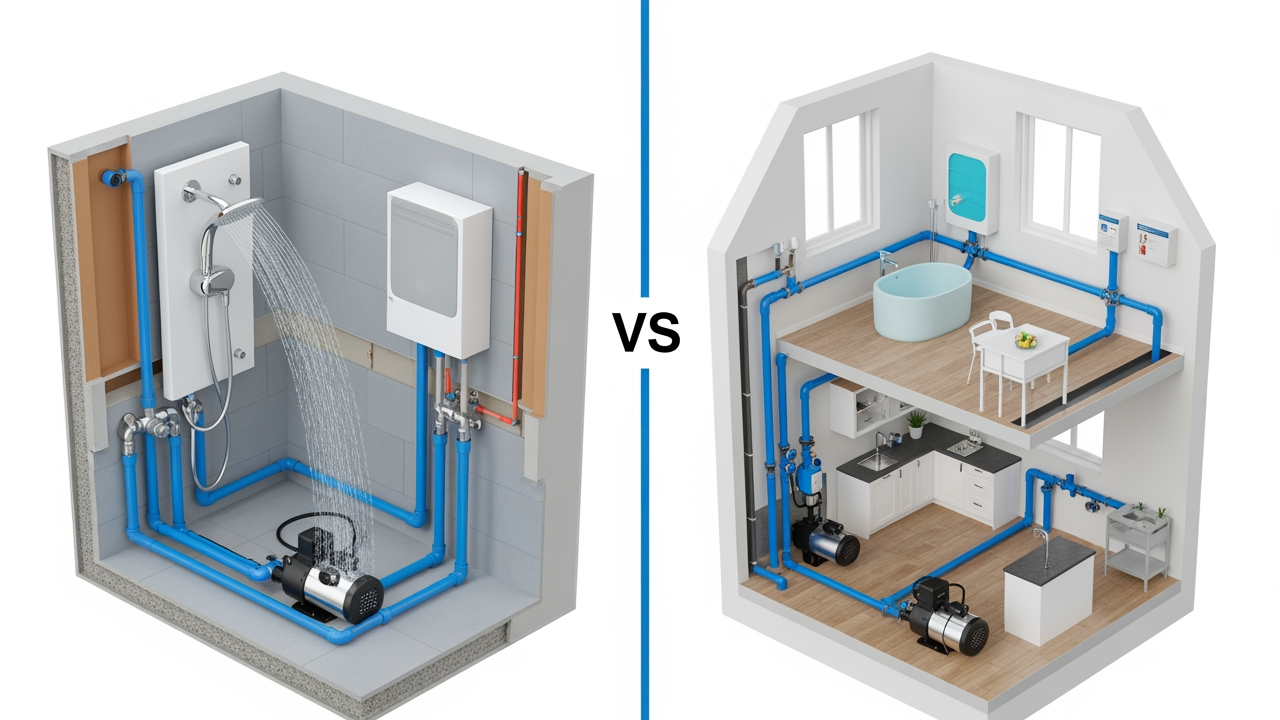
Low water pressure ruins more than morning showers. It affects washing machines, dishwashers, multiple bathrooms running simultaneously, and even basic tasks like filling a kettle. When facing pressure problems, you'll encounter two main solutions: whole-house pump systems and single shower pumps. Each serves different needs, costs different amounts, and solves different problems.
What Single Shower Pumps Actually Do
A single shower pump boosts water pressure to one specific outlet, typically your shower. The pump sits between your cold water tank and the shower, activating when you turn on the water. Most units cost between £150 £ 400 and take 2-3 hours to install.
These pumps work well in specific scenarios. If your shower dribbles whilst kitchen taps run fine, a single pump solves the problem. If you live alone or rarely run multiple water outlets simultaneously, you won't notice the limitation. The pump delivers 1.5-3.0 bar pressure to that one shower, transforming a weak trickle into proper flow.
The catch: nothing else improves. Your kitchen tap still runs at low pressure. Your washing machine takes twice as long to fill. If someone flushes a toilet whilst you're showering, you're back to inadequate pressure.
How Whole House Pump Systems Work
Whole-house pump systems boost pressure throughout your entire property. The pump installs on your main water supply line, increasing pressure to every tap, shower, appliance, and toilet. Modern systems deliver 1.5-4.0 bar pressure consistently across all outlets.
These systems use either single or twin impeller pumps from manufacturers like Stuart Turner, Grundfos, or Lowara. Twin impeller models provide redundancy; if one pump fails, the second maintains pressure whilst you arrange repairs. The pump monitors flow rate and pressure continuously, adjusting output to match demand.
Installation requires more work than single shower pumps. The unit needs mounting near your water tank or incoming mains supply, with electrical connection and integration into existing pipework. Professional installation typically takes 4-6 hours and costs £800-2,500, depending on system complexity and property size.
The benefit shows immediately. Every water outlet operates at proper pressure. You can run multiple showers, fill the washing machine, and run kitchen taps simultaneously without pressure drops. For heating and plumbing systems that rely on consistent pressure, this makes a substantial difference.
Cost Comparison: Initial Investment vs Long-Term Value
Single shower pumps cost £150-400 for the unit plus £100-200 for installation. Total investment: £250-600. If you need pressure in multiple locations, you'll need multiple pumps. Two shower pumps cost £500-1,200. Three locations push costs to £750-1,800.
Whole house pumps cost £400-1,200 for the unit plus £400-1,300 for installation. Total investment: £800-2,500. This single system covers every water outlet in your property.
The mathematics shift quickly. If you need pressure in more than two locations, whole-house systems cost less than multiple single pumps. You also avoid duplicate installation charges and the complexity of maintaining multiple units.
Energy consumption differs, too. A single shower pump uses 150-250 watts when running. If you install three single pumps across your property, you're potentially running 450-750 watts. A whole-house system uses 400-800 watts total, regardless of how many outlets you're using simultaneously. Over a year, this translates to £40-80 in electricity costs for whole house systems versus £30-90 for multiple single pumps, depending on usage patterns.
Performance Under Real Conditions
Single shower pumps excel in one scenario: boosting a single, specific outlet in a property where other water pressure is adequate. They're ideal for loft conversions where the new bathroom sits higher than the cold water tank, creating insufficient pressure through gravity alone.
The limitation emerges when multiple people use water simultaneously. Your shower runs at full pressure until someone turns on a kitchen tap. The cold water tank supplies both, but the pump only boosts the flow to the shower. When demand increases elsewhere, available water to the shower decreases, and pressure drops despite the pump.
Whole-house pump systems maintain consistent pressure across all outlets because they boost the entire supply. When someone turns on a second shower, the pump increases output to maintain pressure at both locations. Modern systems handle flow rates up to 60 litres per minute, enough for two showers, a washing machine, and kitchen taps running simultaneously.
This matters more than marketing materials suggest. The average household uses water at 3-4 different outlets during peak morning hours. Without whole-house pressure, someone's shower always suffers when another family member starts the washing machine or fills the kettle.
Installation Requirements and Property Considerations
Single shower pumps require a cold water tank (header tank) in your loft. They don't work with mains-fed systems or combination boilers. The pump needs mounting somewhere between the tank and shower, usually in an airing cupboard or loft space. You'll need:
- Access to electrical supply (standard 13-amp socket)
- Space for a unit roughly 30cm x 20cm x 15cm
- Pipework modifications using quality fittings to route water through the pump
- Adequate flow from the cold water tank
Properties with combination boilers or mains pressure systems can't use traditional single shower pumps. You'd need a different solution entirely.
Whole-house pump systems offer more flexibility. They work with both tank-fed and mains-fed supplies, though installation differs:
For tank-fed systems: The pump installs after the cold water tank, boosting pressure throughout the distribution network. This requires a tank with adequate capacity (minimum 200 litres recommended) to supply the pump's flow rate. Cylinders from Gledhill or Kingspan often work well with these systems.
For mains-fed systems: The pump installs on the incoming mains supply. This requires checking that your mains supply delivers an adequate flow rate (typically 20+ litres per minute). You may also need to notify your water supplier, as regulations govern mains water boosting in some areas.
Space requirements increase with whole-house systems. The unit measures 40-60cm in height, 30-40cm in width, and 20-30cm in depth. You'll need access for maintenance and enough clearance for pipework connections.
Noise matters more with whole-house systems because they run whenever anyone uses water anywhere in the property. Quality units operate at 45-55 decibels, roughly equivalent to a quiet conversation. Cheaper models reach 60-70 decibels, which becomes intrusive if the pump sits near living spaces. Mounting location affects this significantly. A pump in a basement or utility room causes minimal disruption. One mounted in a cupboard adjacent to bedrooms will wake light sleepers.
Maintenance and Reliability Over Time
Single shower pumps contain fewer components and simpler mechanisms. The impeller, motor, and pressure switch handle straightforward tasks. Annual maintenance involves checking connections, testing the pressure switch, and verifying the impeller spins freely. Most units run 8-12 years before requiring replacement.
Common failures include:
- Pressure switch malfunction (£40-60 to replace)
- Impeller damage from debris (£60-100 to replace)
- Motor burnout from running dry (£80-150 to replace, often cheaper to buy a new unit)
Whole-house systems require more attention because they work harder. The pump runs more frequently, handles greater volume, and manages varying demand. Professional servicing every 2-3 years costs £80-120 and includes:
- Pressure vessel recharging
- Filter cleaning or replacement
- Electrical connection inspection
- Flow sensor calibration
- Impeller condition assessment
Quality whole-house pumps last 12-18 years with proper maintenance. The higher initial cost spreads across more years of service.
The critical difference: when a single shower pump fails, one shower loses pressure. When a whole-house pump fails, your entire property drops to the original (inadequate) pressure. This makes twin impeller systems worth considering for larger households or properties where consistent pressure is essential. The second pump provides backup, and the system switches automatically if the primary pump fails.
Which Properties Benefit Most from Each Option
Single shower pumps work best for:
- Properties with one bathroom where only the shower has inadequate pressure
- Loft conversions or extensions where the new bathroom sits above the cold water tank
- Single-occupant properties where simultaneous water use rarely occurs
- Rental properties where landlords want to address a specific complaint cost-effectively
- Situations where budget constraints make whole-house systems impractical
Whole-house pump systems suit:
- Properties with multiple bathrooms
- Households with 3+ occupants
- Homes where appliances (washing machines, dishwashers) also suffer from low pressure
- Properties with combination boilers where single pumps won't work
- New builds or major renovations where comprehensive solutions make sense
- Properties with gravity-fed heating systems that benefit from improved circulation
The decision often comes down to how many locations need pressure improvement. One location: single pump makes sense. Two or more: whole-house systems deliver better value and performance.
Common Mistakes When Choosing Between Systems
Underestimating simultaneous usage: Many people choose single shower pumps, thinking they'll save money, then discover the limitation when family members' schedules overlap. Morning routines involve more simultaneous water use than expected.
Ignoring appliance needs: Low pressure affects washing machine performance, dishwasher efficiency, and even toilet cistern refill rates. These don't seem urgent until you're waiting five minutes for a toilet to refill or your washing machine takes three hours for one cycle.
Buying undersized whole-house pumps: A 1.5 bar pump barely improves pressure if you're starting from very low pressure. For properties with serious pressure problems, 2.5-3.0 bar systems provide noticeable improvement. Calculate your actual needs based on the number of bathrooms and typical usage patterns.
Installing pumps without checking water supply capacity: Pumps can't create water; they only boost the pressure of the available supply. If your cold water tank refills slowly or your mains supply delivers a low flow rate, the pump will run dry or cycle on and off constantly. This damages the pump and wastes electricity. Check supply capacity before selecting any pump system.
Positioning pumps incorrectly: Mounting a whole-house pump directly beside a bedroom guarantees noise complaints. Single shower pumps installed too far from the shower waste pressure through pipe friction. Location matters as much as the pump itself.
Making the Right Choice for Your Property
Start by measuring your actual pressure at multiple locations. Water pressure gauges cost £10-15 and screw onto any tap. Test pressure at different times of day, particularly during peak usage hours. If only one location shows inadequate pressure whilst others perform adequately, a single pump makes sense. If multiple locations struggle, whole-house systems provide better solutions.
Calculate how many outlets you use simultaneously during typical routines. If your household regularly runs two showers, a washing machine, and kitchen taps at the same time, you need a system that maintains pressure under that load. Single pumps can't deliver this.
Consider your property's future. If you're planning bathroom additions, loft conversions, or family expansion, installing a whole-house system now avoids retrofitting costs later. The system already handles increased demand.
Check your water supply type. Properties with combination boilers need whole-house systems designed for mains pressure boosting; single shower pumps won't work. Properties with cold water tanks can use either option, but whole-house systems still offer better long-term value if you need pressure in multiple locations.
Budget matters, but calculate total costs properly. Three single shower pumps installed over five years cost more than one whole house system installed once. Factor in installation charges, maintenance costs, and energy consumption over the system's expected lifespan.
Conclusion
The choice between whole-house pump systems and single shower pumps depends on how many locations need improved pressure and how many people use water simultaneously. Single shower pumps solve specific, isolated pressure problems cost-effectively. They work well for properties where only one outlet struggles, whilst others perform adequately.
Whole-house pump systems deliver better value when multiple locations need improvement or when households regularly use several water outlets at once. The higher initial cost is distributed across every tap, shower, and appliance in your property, and the system maintains consistent pressure regardless of simultaneous demand.
For most properties experiencing pressure problems in more than one location, whole-house systems provide superior long-term solutions. They cost less than multiple single pumps, require less maintenance complexity, and deliver performance that matches how modern households actually use water. The investment pays back through reliable pressure at every outlet, reduced waiting times for appliances, and the flexibility to add bathrooms or fixtures without pressure concerns.
For expert guidance on selecting whole-house pumps or single shower pump solutions, Heating and Plumbing World provides comprehensive support. Browse quality pumps from Stuart Turner, Grundfos, and Lowara, along with essential components from Gledhill, Kingspan, and quality fittings for professional installations.