

Why Grundfos Remains the Industry Standard for Pumps
When you are specifying a pump for a commercial heating system or a domestic hot water recirculation loop, you are making a decision that will affect system performance for the next fifteen to twenty years. Get it wrong, and you will face callbacks for noise complaints, efficiency issues, or premature failure. Get it right, and the system runs so quietly and efficiently that nobody thinks about it again until the next service interval.
Grundfos pumps have held their position as the industry benchmark for decades, and that is not just clever marketing. It is the result of consistent engineering excellence, a relentless focus on energy efficiency, and a support infrastructure that actually works when you need it. From the heavy-duty commercial circulators that have become standard on large boiler installations to the smaller models that have transformed domestic heating efficiency, the brand has earned its reputation through performance on real-world projects.
The question isn't whether Grundfos pumps work; it is whether they justify the premium over cheaper alternatives. For trade professionals who value reliability, warranty support, and long-term running costs over the initial purchase price, the answer is consistently yes.
Engineering That Solves Real Problems
The difference between a well-engineered pump and a mediocre one becomes obvious around year five of operation. Cheaper units might perform adequately when new, but they are the ones that start developing bearing noise, losing efficiency, or failing completely just outside the warranty period. Premium circulators are designed with longevity baked into every component choice.
Permanent magnet motor technology is a perfect example of this commitment to quality. The flagship series uses synchronous permanent magnet motors that deliver efficiency levels impossible with traditional induction motors. You are looking at a highly impressive Energy Efficiency Index rating below 0.20 on most modern models. That Energy Efficiency Index translates to roughly 80% less energy consumption than an old uncontrolled circulator. Achieving a top-tier Energy Efficiency Index means the unit easily surpasses modern building regulations and slashes running costs.
The intelligent adaptation features take this further. The pump continuously monitors system demand and adjusts its output accordingly. During mild weather when only a few radiators are calling for heat, it drops to minimal speed. When the whole building needs warming, it ramps up to meet the demand perfectly.
Reliability You Can Actually Depend On
Here is a scenario that will be familiar to any heating engineer: you are called back to a job six months after commissioning because the pump has failed. The client is furious, you are losing money on a warranty repair, and you are fitting a replacement that might only last another six months if you are lucky. It is exactly the kind of situation that damages your reputation and eats into profit margins.
Investing in premium equipment dramatically reduces this risk. A solid three-year manufacturer warranty is backed by a company that has been operating since 1945 and is not going anywhere. When you do need replacement components, expert suppliers like Heating and Plumbing World stock the full range and can get parts to you quickly.
The build quality is immediately apparent when you handle one. The stainless steel pump housing resists corrosion even in systems with poor water quality. The shaft and bearings are engineered for continuous operation under varying loads. These aren't components chosen to hit a budget price point; they are specified to last.
Installation That Doesn't Waste Your Time
Time on site is money. A pump that takes twenty minutes to commission instead of five costs you heavily on every single job. Modern Grundfos pumps are clearly designed with installers in mind, not just the end-users.
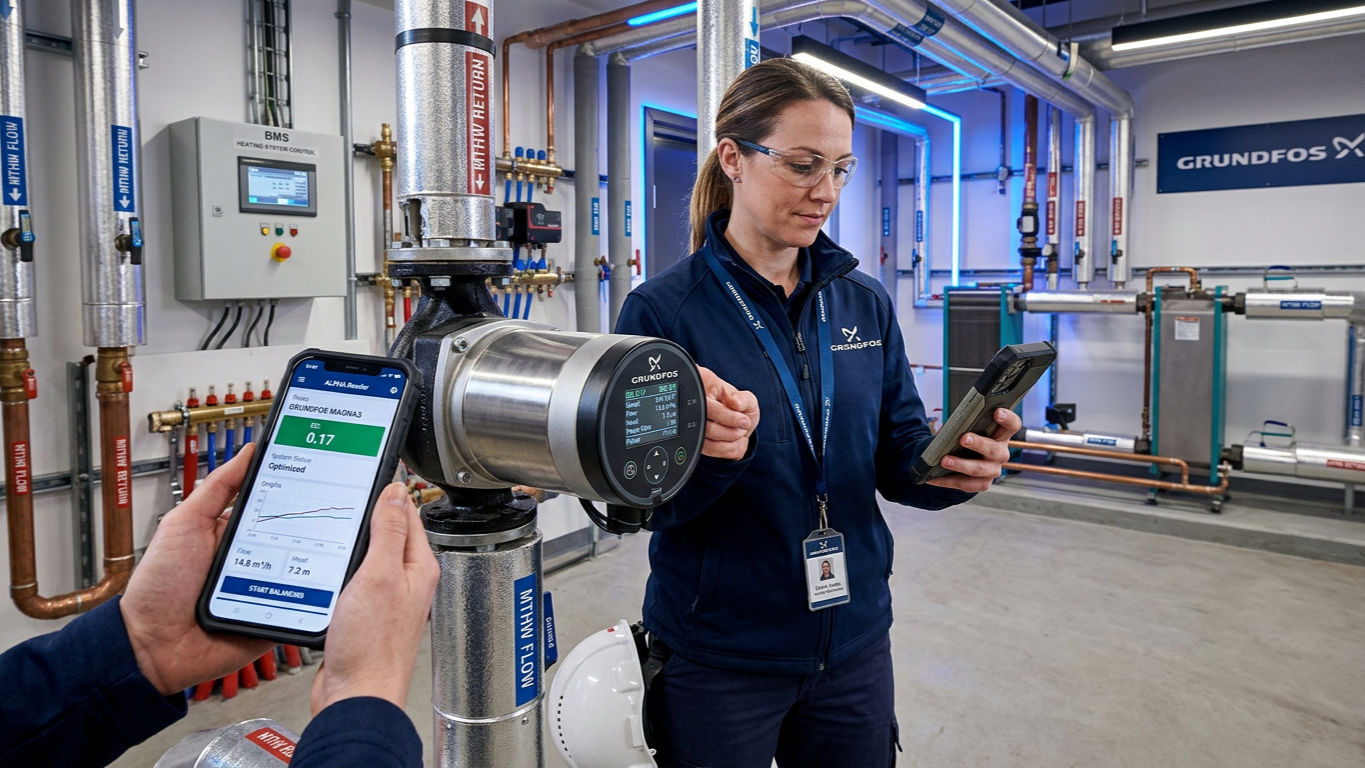
The latest balancing apps transform commissioning from complete guesswork into exact precision. You connect via Bluetooth to the pump, check actual flow rates and head pressure, and adjust settings in real-time. On a recent multi-storey office refit, an engineer struggled for hours trying to balance a complex heating circuit manually. Switching to the app-based balancing tool allowed them to pinpoint the exact flow issues within twenty minutes, saving the entire commissioning schedule from catastrophic delays.
Quick-release couplings on most models mean you can swap a failed pump without draining the entire system. The orientation of the terminal box can be rotated in 90-degree increments, so you are not fighting with cable entry positions in tight plant rooms.
Performance Across the Full Operating Range
A performance curve tells you everything about how a pump will behave in your system. Cheap pumps often have extremely narrow sweet spots, meaning they work adequately at one specific duty point but struggle immensely when conditions change. A premium unit maintains efficiency across a much broader range, easily outperforming a standard domestic shower pump or budget heating circulator.
This adaptability matters because systems change over their lifetime. Rooms get extended, radiators get added, and controls get upgraded. A pump that can adapt maintains high performance, while one that cannot becomes an immediate bottleneck.
The Energy Efficiency Argument
Energy costs have transformed from a minor consideration to a major operating expense. A heating system running an old fixed-speed circulator can easily consume 400 to 600 kWh annually just on the pump. Multiply that by current electricity prices, and you are looking at £150 to £200 per year just to move water around.
Modern circulators in the same application typically consume 50 to 80 kWh annually. Over a fifteen-year lifespan, the pump pays for itself several times over purely through reduced electricity bills. For commercial systems with larger pumps, the savings scale proportionally and provide massive financial relief for building owners.
Support When Things Go Wrong
The best pump in the world is only as good as the support behind it when something eventually fails. The technical helpline is staffed by people who understand heating systems, not script-reading call centre operators. When you are troubleshooting a fault on site, that distinction matters heavily.
Spare parts availability means you are not waiting weeks for a replacement seal or control module. The online product documentation is incredibly comprehensive and genuinely useful. When you are on site and need to check something, you can pull up the exact specification on your phone in seconds.
Innovation That Matters
Some manufacturers innovate solely for the sake of marketing headlines. True innovation solves the actual problems that installers and building operators face daily.
Setting the Constant Curve mode maintains a proportional pressure relationship across the flow range. Utilising Constant Curve mode is ideal for systems with variable flow requirements, preventing over-pressurisation at low flow rates that can cause severe noise and valve wear. The introduction of Constant Curve mode emerged from understanding real system behaviour rather than theoretical engineering.
Think of this variable speed drive like adaptive cruise control on the motorway. Instead of keeping your foot planted on the accelerator regardless of traffic, the system automatically slows down and speeds up to match the cars ahead perfectly.
Using the ALPHA Reader app provides a simple interface for quick checks on site. You simply scan the pump with the ALPHA Reader app to get real-time insights without needing to be a heating system control specialist. The ALPHA Reader app allows contractors to extract data instantly, ensuring the system is running at optimal efficiency.
Comparing the Alternatives
It is worth acknowledging that there are other high-quality pump manufacturers. You can find excellent heating system components danfoss and similar brands producing reliable circulators. So why does this specific brand consistently remain the first choice for so many installers?
Market presence is a huge part of it. These pumps are so widely specified that most merchants stock them as standard. Familiarity matters too. When every heating engineer knows how to commission the unit, you are not creating training overheads or increasing the chance of installation errors.
Where Grundfos Fits in Modern Systems
Modern heating systems are increasingly complex. Weather compensation controls, zone valves, mixing circuits, and integration with renewable technologies all place new demands on circulators.
Premium commercial pumps integrate seamlessly with building management systems via Modbus or BACnet protocols. Utilising BACnet protocols allows the facilities manager to monitor pump status and log performance data remotely. When dealing with BACnet protocols, the integration is completely effortless for large central controls.
Domestic systems benefit just as heavily. Pairing an intelligent pump with a smart trv network creates a system that is incredibly efficient and responsive.
The Total Cost Perspective
Whether you are specifying a premium commercial circulator or a standard water circulation pump for a secondary loop, the initial purchase price is just one single component of the total cost of ownership. When you factor in installation time, energy consumption, reliability, and warranty support, the calculation shifts dramatically.
A cheap pump that costs £80 but fails after three years costs you far more than a £200 premium unit that lasts fifteen years, consumes £30 in electricity, and installs in five minutes. The maths isn't complicated; quality absolutely pays for itself.
Conclusion
The dominance of premium manufacturers in the pump market isn't accidental or purely the result of marketing spend. It is earned through decades of engineering excellence, genuine innovation that solves real problems, and a support infrastructure that works when you need it.
For heating engineers and installers, the choice often comes down to risk management. You can experiment with cheaper alternatives and hope they perform adequately, or you can specify industry-standard components and know with confidence exactly what you are getting. The premium you pay upfront acts as insurance against callbacks, efficiency complaints, and premature failure.
If you are specifying pumps for your next project and want to explore the best options, contact our support team for technical guidance and competitive pricing. The right pump choice today prevents frustrating problems for years to come.